When you see a division problem such as , you may know the answer is 5 remainder 2. But what do the four names mean? Which number is the dividend? What makes 2 the remainder instead of part of the quotient?
The names become easier to remember when you connect them to one idea: division asks how many equal groups fit, and what is left after making as many full groups as possible.
The four parts of division
In remainder :
- Dividend: 17, the amount being divided.
- Divisor: 3, the number you divide by. In this grouping example, it is the size of each group.
- Quotient: 5, the answer to the whole-number division. In this example, it counts the full groups.
- Remainder: 2, the amount left after making those groups.
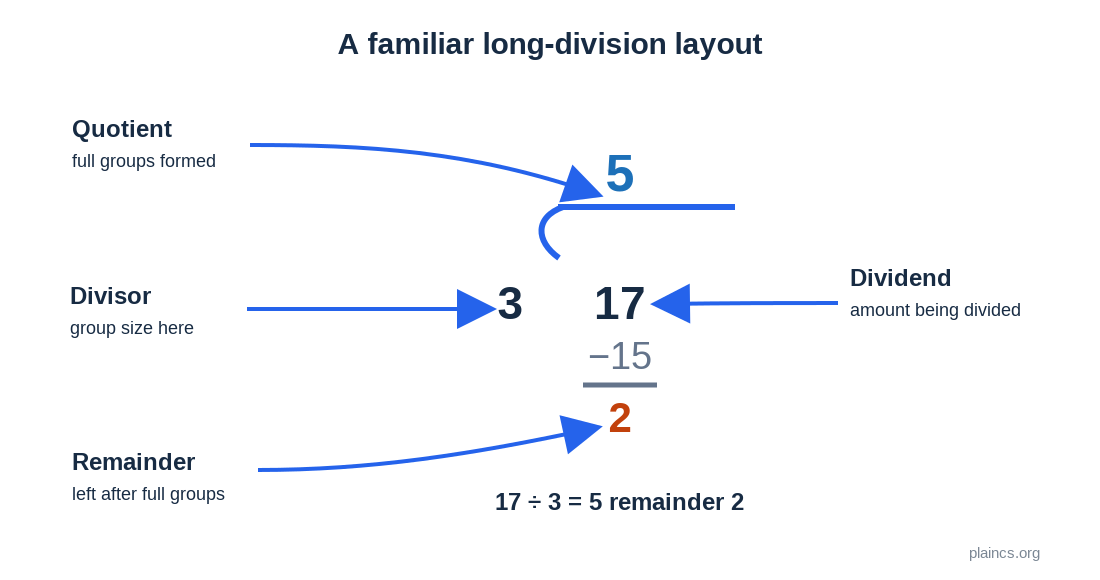
You may recognize the bracket from school. The divisor sits outside, the dividend inside, the quotient above, and the remainder at the bottom.
OpenStax uses the same names: the number being divided is the dividend, and the number dividing it is the divisor. The result of the division is the quotient. In a division-with-remainder problem, the remainder is the part that cannot make another full group. OpenStax: Divide Whole Numbers
See the division as groups
Suppose 17 people are making teams of 3. You can make five full teams. That uses 15 people, and 2 people remain without a full team.
So:
The quotient answers how many full groups? The remainder answers how many are left?
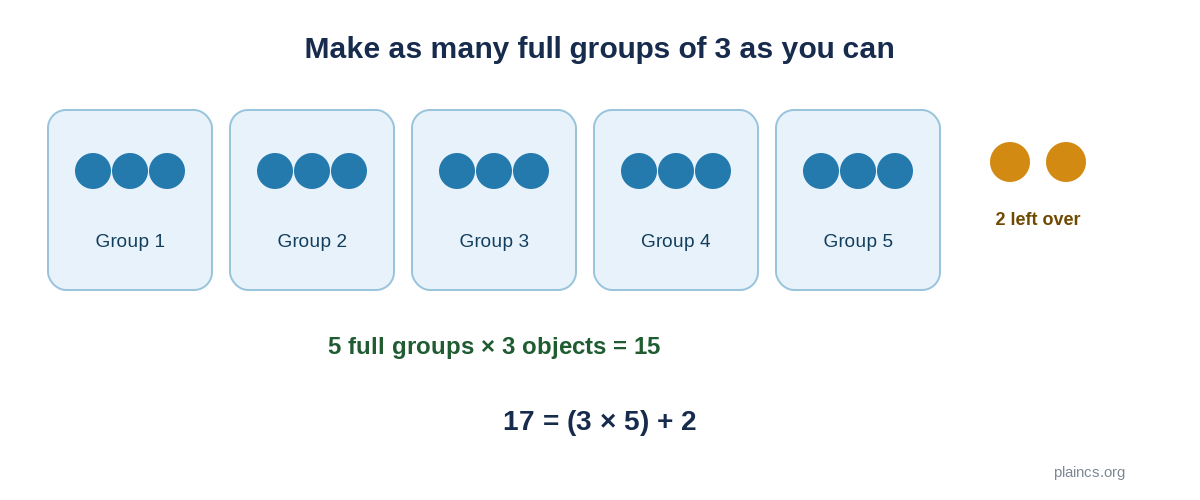
Five teams of three use 15 people. Two people remain, so 17 divided by 3 is 5 remainder 2.
The same idea works for objects, pages, seats, or anything you can count. If 23 books go into boxes that hold 4 books each, you fill 5 boxes and have 3 books left. The quotient is 5; the remainder is 3.
There is another useful way to picture the same calculation. Instead of asking “How many groups of 3 fit into 17?”, share 17 objects among 3 people. Each person gets 5, and 2 objects are left over. The quotient is still 5 and the remainder is still 2, but now 5 describes how many objects each person gets. The context tells you whether the divisor is the number of groups or the size of each group.
The equation that ties the terms together
Every whole-number division with a remainder can be checked using this equation:
For :
Five groups of three account for 15. Add the 2 left over, and you get the original 17. This is why multiplication can check a division answer.
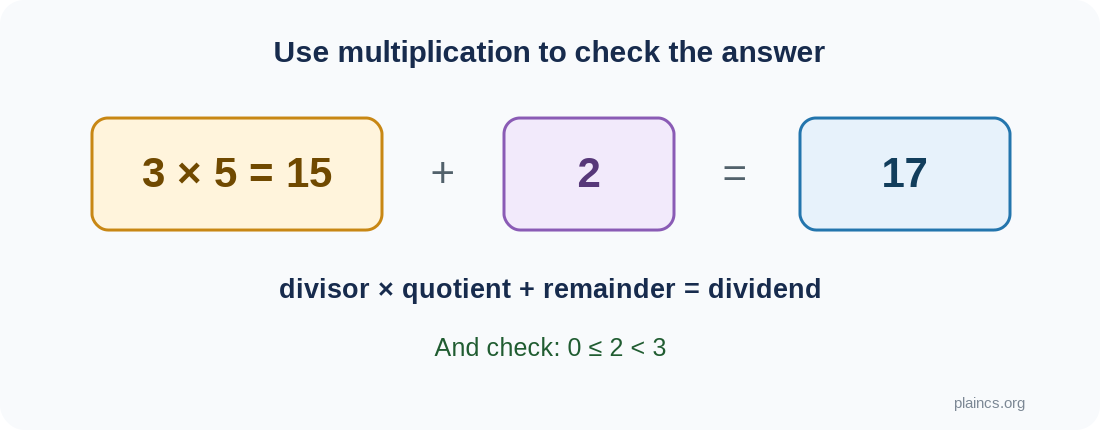
Multiply the divisor by the quotient, then add the remainder. The result should be the dividend.
The equation also gives you a way to find a missing number. If you know the dividend is 29, the divisor is 6, and the quotient is 4, then the remainder must be 5 because .
Why the remainder must be smaller than the divisor
The remainder is what remains after making as many full groups as possible. If you have 17 items and are making groups of 3, a remainder of 3 would mean you still have enough for one more group. Then the quotient would be 6 and the remainder would be 2.
For a positive divisor, the remainder must follow this rule:
Here is the remainder and is the divisor. The remainder can be zero, but it cannot be negative or as large as the divisor.
More generally, when the dividend or divisor may be negative, the standard Euclidean division rule is:
Here is the dividend, is a nonzero divisor, is the quotient, and is the remainder. For any two integers with a nonzero divisor, there is exactly one quotient and remainder that satisfy this rule. Wikipedia: Euclidean division
What happens when division is exact?
Sometimes nothing is left over. For example:
You can write the remainder as zero: . A zero remainder means the divisor goes into the dividend evenly. It also means that the dividend is a multiple of the divisor.
This gives a quick way to check divisibility. If , then is divisible by 4. The modulo operation, often written % in programming, returns a remainder. It is useful when checking whether a number is even, wrapping around a list, or splitting work into equal batches.
Quotient and remainder are not the same as a decimal answer
The phrase “divide 17 by 3” can ask for different forms of the answer.
- As a fraction: .
- As a decimal: .
- As integer division with a remainder: 5 remainder 2.
These forms agree because:
The quotient 5 counts complete groups. The fraction describes the remaining part as a share of another group. The decimal expresses the same value in a different form.
This distinction matters in programming. In Python, 17 / 3 gives a decimal value, while 17 // 3 gives the floor quotient and 17 % 3 gives the remainder. Python’s divmod(17, 3) returns both values together: (5, 2). Python: An Informal Introduction
A note about negative numbers
With positive whole numbers, the rules feel natural. Negative numbers make the choice of division convention visible.
Under Euclidean division, divided by 3 is written with a non-negative remainder:
So the quotient is and the remainder is 1. The remainder still satisfies .
Some programming languages use a different rule for integer division. The C standard says the fractional part of the quotient is discarded, which means it rounds toward zero. Under that rule, gives quotient and remainder :
Both pairs reconstruct the dividend. The difference is the rule used to choose the quotient and remainder. Python’s // rounds down instead, so its results follow the Euclidean-style result for a positive divisor. When code handles negative numbers, check the language’s definition of division and remainder instead of assuming every % operator behaves the same. ISO C standard, §6.5.6 · Python expression reference
Division by zero
The divisor cannot be zero. There is no number you can multiply by zero to get 17, so has no defined answer. Zero divided by a nonzero number is different: with remainder 0.
This is also a useful programming check. If a divisor comes from user input or a calculation, make sure it is not zero before dividing. In C, integer division by zero has undefined behavior; Python raises a ZeroDivisionError for integer division by zero.
A reliable way to solve and check a problem
For whole-number division with a positive divisor:
- Find the largest whole-number multiple of the divisor that does not exceed the dividend.
- The multiplier is the quotient.
- Subtract that product from the dividend to get the remainder.
- Check that the remainder is at least 0 and smaller than the divisor.
- Check the identity: dividend = divisor × quotient + remainder.
For example, divide 83 by 9. The largest multiple of 9 below 83 is 81, or . The quotient is 9, and , so the remainder is 2.
Check it:
And check the bound: . Both checks pass, so 83 divided by 9 is 9 remainder 2.
Common mistakes
- Swapping the dividend and divisor. In , 17 is divided by 3. The order matters.
- Calling the decimal part the remainder. The remainder in integer division is a whole number. The fraction is the leftover expressed as part of another group.
- Leaving a remainder as large as the divisor. If the remainder is 3 when dividing by 3, one more full group can be made.
- Checking only that the equation works. Several pairs can satisfy if there is no bound on . The remainder rule identifies the standard quotient and remainder.
- Assuming every programming language handles negative division the same way. Floor division and truncation toward zero can produce different quotient and remainder values.
Try these
- What are the quotient and remainder when 32 is divided by 5?
- What are they when 48 is divided by 8?
- Can a remainder be 8 when the divisor is 8?
Answers: 1. Quotient 6, remainder 2, because . 2. Quotient 6, remainder 0. 3. No. A remainder must be smaller than the divisor; 8 more means there is another full group.
The short version
The dividend is what you start with. The divisor sets the group size. The quotient counts the complete groups. The remainder is what is left.
Remember one equation and you can check them all:
For ordinary division with positive whole numbers, also check that the remainder is at least zero and smaller than the divisor.
Sources and further reading
- OpenStax: Divide Whole Numbers — grouping, long division, and the remainder.
- Wikipedia: Euclidean division — the quotient-and-remainder identity and the general remainder bound.
- Wolfram MathWorld: Division — terminology and why division by zero is undefined.
- Python tutorial: Using Python as a calculator —
/,//,%, anddivmod()examples. - ISO C standard, §6.5.6 — integer quotient and remainder behavior in C.
Related articles in Math for Computing
- Compiler vs Interpreter: What's the Difference? — A compiler translates a program before it runs; an interpreter executes it as it goes. Learn how each works, the trade-offs, and why most languages mix both.
- Programming vs Coding: What's the Difference? — Coding is writing instructions in a language; programming is the whole process of solving a problem with software. See how the two differ and overlap.
- Why Learn Computer Science When AI Can Code? — AI can write code, build applications, and fix bugs. So is studying computer science still worth it? Explore what programming alone cannot teach you and why understanding technology matters more than ever.