Where does a model get its learning signal?
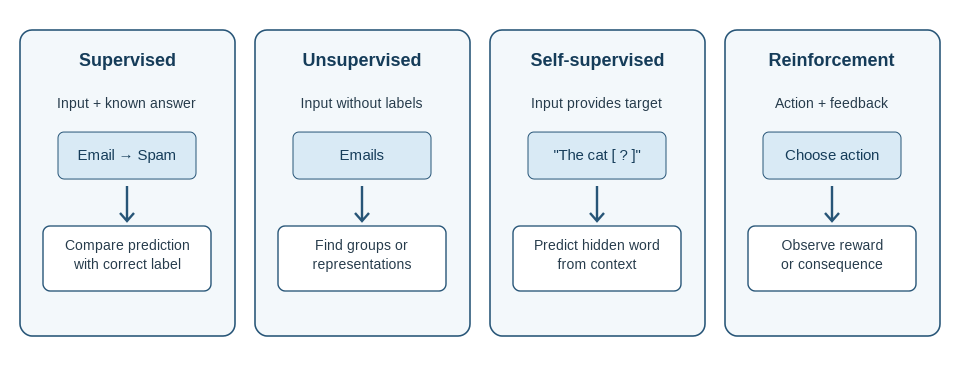
Consider teaching a program to recognize photographs of cats. You could provide images with correct “cat” or “not cat” labels. That is supervised learning: the system receives examples together with the desired answers.
But suppose you have thousands of images without labels. You might ask the system to find recurring patterns or groups. That is often unsupervised learning. You could also create a training task from the images themselves, such as learning to reconstruct missing parts. That is self-supervised learning.
Now imagine a robot learning to move toward a charging station. It takes actions, observes consequences, and receives rewards or penalties. This is a setting for reinforcement learning. The difference is not just the dataset: the learner can affect the observations it receives.
These approaches are called learning paradigms because they describe the origin and structure of feedback. They are not single algorithms. A neural network, for example, can be trained with labeled examples, self-generated targets, or reward-based objectives.
As you read, focus on three questions for each paradigm: What information is available? What tells the model it is improving? What kind of problem is that feedback suited to?
A machine-learning paradigm describes how a model obtains the information needed to learn. Some models learn from examples with known answers; some discover structure without those answers; others construct their own training signals or learn from the consequences of actions.
This classification matters because the available data and feedback often determine which approach is practical. Before choosing a neural network or a decision tree, ask a simpler question: What signal tells the system whether it is learning something useful?
The six important concepts discussed here are supervised learning, unsupervised learning, semi-supervised learning, self-supervised learning, reinforcement learning, and transfer learning. They are not six mutually exclusive categories: transfer learning can be combined with supervised learning, for example, and self-supervised pretraining is often followed by supervised fine-tuning.
1. What is a learning signal?
A learning signal is information used to guide changes in a model, such as a correct target, a reward, or a measurable objective derived from the input. Machine-learning algorithms use that signal to select parameters, representations, or policies that serve a task.
Consider a collection of customer-support messages:
- If each message is labeled billing, technical, or account, a model can learn from those known answers.
- If the messages have no labels, a model can group messages with similar content.
- If only some messages are labeled, the model may combine labeled and unlabeled examples.
- If parts of the messages are hidden and the system learns to predict those parts, the training task supplies its own target.
- If an assistant takes actions and receives rewards for resolving cases efficiently, the feedback can guide a decision-making policy.
These are different training arrangements, even when they begin with similar data.
2. Supervised learning
Supervised learning trains a model using examples that associate inputs with known target outputs. The objective is to learn a relationship that generalizes to new inputs.
Represent a training dataset as pairs , where is the input and is the desired target. For a model , a typical training objective is:
Here denotes learnable parameters, measures prediction error, and is the number of training examples. The formula describes a common supervised-learning setup; particular algorithms may use different objectives and optimization methods.
Main supervised tasks
| Task | Target | Example | Common metrics |
|---|---|---|---|
| Classification | Discrete category | Spam versus legitimate email | Precision, recall, F1-score |
| Regression | Numerical value | Predicting electricity demand | MAE, RMSE |
| Ranking with labeled relevance | Relative preference or relevance | Ordering search results | NDCG, Precision@K |
A supervised spam classifier can learn from past messages labeled spam or not spam. At inference time it predicts a label for a message it has never seen.
Strengths: The goal is explicit, performance can be tested against held-out targets, and many well-established algorithms are available.
Limitations: Reliable labels may be expensive or inconsistent. Poorly selected samples, changing conditions, and label leakage can produce misleading performance.
3. Unsupervised learning
Unsupervised learning uses input observations without a separately provided correct output for each example. Its goal is commonly to discover meaningful structure or representations in the data.
For example, an online shop may have customer purchasing histories but no predefined customer-group labels. A clustering algorithm can identify groups based on similarities among purchase patterns.
Important unsupervised tasks include:
| Task | What it seeks | Representative technique |
|---|---|---|
| Clustering | Groups of similar observations | K-means |
| Dimensionality reduction | A smaller representation preserving useful structure | Principal Component Analysis (PCA) |
| Density estimation | An approximation of the data distribution | Mixture models |
| Representation learning | Useful features without a task-specific label | Autoencoders and other approaches |
Not every cluster is a real-world category. Groups can change with the features, scaling method, distance measure, and algorithm settings. A clustering result must therefore be interpreted in the context of the actual problem.
Strengths: It can use datasets that lack costly human labels and can reveal patterns worth investigating.
Limitations: Evaluation is less direct than comparing predictions with known target values. Discovered patterns may be unstable or not useful for the intended decision.
4. Semi-supervised learning
Semi-supervised learning uses a relatively small amount of labeled data together with a larger amount of unlabeled data to improve learning for a task.
Suppose a medical imaging project has 500 carefully reviewed images with diagnoses and 20,000 images without labels. Under suitable assumptions, the unlabeled images may help a model learn the structure of the data while the labeled set identifies the target categories.
Common strategies include:
- Pseudo-labeling: A model predicts labels for selected unlabeled examples, then uses sufficiently reliable predictions as additional training targets.
- Consistency regularization: A model is encouraged to produce compatible predictions for modified versions of the same unlabeled input.
- Graph-based methods: Relationships among labeled and unlabeled observations help propagate information.
The extra unlabeled data is not automatically beneficial. If the unlabeled collection comes from a different distribution, or pseudo-labels are systematically wrong, performance can worsen. Validation must reflect the intended use case.
Key distinction: In semi-supervised learning, some labels are supplied externally for the target task. In self-supervised learning, a training signal is generated from the data itself.
5. Self-supervised learning
Self-supervised learning constructs prediction targets from the data, rather than requiring a person to annotate each example for the pretraining task.
Examples include predicting a hidden word from surrounding text, predicting the next token from earlier tokens, or learning representations by comparing related views of an image.
Consider the sentence:
The student opened the [MASK] to read the chapter.
A training system may hide book and use the original sentence to supply the target. The model learns features of language by repeatedly solving such tasks across many texts.
A typical workflow is:
- Collect suitable unlabeled data.
- Define a task that derives targets from the available inputs.
- Train the model to solve that task.
- Reuse its learned representation or adapt it for a downstream task.
Self-supervised learning is especially important in language and vision model pretraining. For instance, next-token prediction is a self-supervised objective used in many language models.
Strengths: Training signals can be generated at large scale without task-specific manual annotation.
Limitations: Success on the pretraining objective does not guarantee reliable performance on every downstream task. The quality, coverage, and biases of the source data still matter.
6. Reinforcement learning
Reinforcement learning (RL) concerns an agent that learns to choose actions through interaction with an environment, guided by reward or other evaluative feedback.
The standard terminology is:
| Term | Meaning |
|---|---|
| Agent | The decision-making learner |
| Environment | The system with which the agent interacts |
| State or observation | Information describing the current situation |
| Action | A choice available to the agent |
| Reward | Numerical feedback associated with an action or transition |
| Policy | A rule or model for selecting actions |
| Return | A measure of accumulated future reward |
An agent controlling a simulated robot might choose a movement, observe the resulting position, and receive rewards for reaching a destination while avoiding collisions.
Many RL methods aim to maximize expected discounted return:
Here is the policy, is the reward at time , is a discount factor (typically between 0 and 1), and represents a finite horizon in this expression. Infinite-horizon formulations are also common.
Two distinguishing challenges are:
- Exploration versus exploitation: Should the agent try an unfamiliar action or use an action already known to work well?
- Delayed consequences: An action may affect rewards received much later.
Reinforcement learning appears in game playing, certain robotics problems, control, resource allocation, and some forms of model post-training.
Limitations: Interactions may be expensive or unsafe, rewards may be badly designed, and training can be unstable. Many decision problems are better solved with simpler control or optimization techniques.
7. Transfer learning
Transfer learning reuses knowledge obtained from one learning problem to help with another. It describes how prior learning is reused, not a distinct source of feedback like labels or rewards.
A model trained on a broad collection of images may learn representations of edges, shapes, and visual patterns. A developer can adapt that pretrained model to classify a smaller set of industrial defects.
Common approaches:
- Feature extraction: Keep a pretrained model mostly fixed and train a new prediction head.
- Fine-tuning: Update some or all pretrained parameters using target-task data.
- Domain adaptation: Adapt a model when the target data distribution differs from the source distribution.
Transfer learning can reduce the amount of task-specific data and computation required. However, transfer may fail when the source and target tasks are too different, a problem sometimes called negative transfer.
Important: Transfer learning can use supervised, self-supervised, or other forms of pretraining. A pretrained language model that is subsequently instruction-tuned illustrates how learning approaches can be combined.
8. Comparing the paradigms
| Paradigm | Primary learning information | Typical purpose | Main challenge |
|---|---|---|---|
| Supervised | Input-target pairs | Predict known labels or values | Obtaining representative, reliable labels |
| Unsupervised | Inputs without task labels | Discover structure | Determining whether patterns are meaningful |
| Semi-supervised | Some labeled and many unlabeled inputs | Improve a labeled task using extra data | Avoiding harmful pseudo-labels or assumptions |
| Self-supervised | Targets derived from the input data | Learn reusable representations | Ensuring representations transfer usefully |
| Reinforcement | Experience and rewards | Learn sequences of actions | Exploration, delayed rewards, safety |
| Transfer | Knowledge from an earlier model or task | Adapt with less new data | Differences between source and target |
These approaches often form a pipeline rather than a strict choice. A team might self-supervise a model on a large dataset, transfer it to a smaller application, and fine-tune it with supervised labels.
9. Worked example: supervised versus unsupervised learning
The following example uses the same small dataset in two different ways. The supervised model predicts whether an observation belongs to a known category; the unsupervised model discovers two groups without being given those category labels.
import numpy as np
from sklearn.cluster import KMeans
from sklearn.linear_model import LogisticRegression

# Each row represents a customer: [visits_per_month, monthly_spend].
X = np.array([
    [1, 20], [2, 25], [2, 40], [3, 35],
    [8, 150], [9, 180], [10, 165], [11, 200],
], dtype=float)

# Labels supplied for the supervised task: 0 = basic, 1 = premium.
y = np.array([0, 0, 0, 0, 1, 1, 1, 1])

classifier = LogisticRegression(max_iter=1000)
classifier.fit(X, y)
print("Supervised prediction:", classifier.predict([[9, 170]])[0])

# Clustering ignores y entirely.
clusterer = KMeans(n_clusters=2, random_state=42, n_init=10)
cluster_ids = clusterer.fit_predict(X)
print("Unsupervised cluster IDs:", cluster_ids)
The two groups found by K-means are numbered arbitrarily: cluster 0 does not inherently mean basic or premium. Unlike supervised learning, clustering has not been asked to reproduce the provided category labels.
This example is intentionally small and illustrative, not a demonstration of reliable customer segmentation. In a real project, scale features when necessary, use representative data, and evaluate predictive models on held-out observations. For more detail, see Feature Engineering, Encoding, and Scaling and Data Splitting, Labeling, and Leakage.
10. How to choose a learning approach
Start with the problem and available feedback, not with a fashionable model name.
- Specify the output. Are you predicting a known answer, finding structure, or choosing actions over time?
- Inspect the data. Are reliable labels available? Is there a large unlabeled collection? Can the system interact with an environment?
- Check existing models. A pretrained model may save substantial time and resources.
- Define a baseline. Test a simple approach before increasing complexity.
- Choose evaluation criteria. Measure outcomes that reflect the intended task, not merely training performance.
- Consider constraints. Account for privacy, data rights, labeling cost, compute, response time, safety, and maintainability.
Common misconceptions
- “Unsupervised means no objective.” Unsupervised methods still optimize defined objectives; they simply do not use externally supplied correct labels for every example.
- “Self-supervised and unsupervised are identical.” Both can use unlabeled datasets, but self-supervision explicitly constructs a predictive target from the data.
- “Reinforcement learning is any learning with feedback.” Its distinctive setting involves actions, environment interaction, and consequences over time.
- “Transfer learning replaces training.” Adaptation may still involve substantial training and evaluation.
- “More data always improves the result.” Data quality, distribution, relevance, and feedback correctness matter more than raw quantity alone.
11. Practice questions
- A school has 50,000 unlabeled student comments and 800 comments labeled by topic. Which learning approaches might use both collections?
- Why is predicting the next word in a sentence a self-supervised training objective?
- What is the difference between clustering customer records and predicting predefined customer segments?
- Why can transferring a model from one dataset to another reduce accuracy rather than improve it?
- In a delivery-routing agent, what could the state, action, and reward represent?
Show suggested answers
- Semi-supervised learning is a candidate; self-supervised pretraining followed by supervised fine-tuning is another possible workflow.
- The original text provides the target token automatically, without requiring a separate human annotation for each prediction.
- Clustering discovers groupings from the data; supervised classification learns to predict categories supplied as targets.
- The pretrained patterns may not match the new data or task, causing negative transfer.
- State: current position and traffic; action: choose the next road; reward: progress or completed deliveries with penalties for time and unsafe choices.
12. Related concepts
- AI Systems, Models, Training, and Inference explains what models learn and how inference differs from training.
- Classification, Regression, Clustering, and Other AI Tasks distinguishes the task from the learning paradigm.
- Data Splitting, Labeling, and Leakage covers label quality and reliable evaluation design.
- How to Formulate an AI Problem provides a workflow for defining practical learning problems.
- Optimization and Gradient Descent introduces the mathematical machinery behind many learning algorithms.
- Linear and Logistic Regression, Clustering and K-Means, and Model Training, Overfitting, and Generalization are planned follow-on articles in the AI Knowledge Map.
References and further reading
- Tom M. Mitchell, Machine Learning (1997). Foundational treatment of learning problems and algorithms.
- Scikit-learn User Guide. Supervised and unsupervised learning approaches with practical examples.
- Richard S. Sutton and Andrew G. Barto, Reinforcement Learning: An Introduction (2nd ed.). Foundational reference for reinforcement learning.
- Google Machine Learning Crash Course. Introductory model training, data, and evaluation concepts.
- Hugging Face Learn. Tutorials covering pretrained models, transfer, and modern deep-learning workflows.
Related articles in
- Clustering and K-Means — Learn how unsupervised clustering discovers groups in data, how K-Means optimizes cluster centroids, and how to evaluate and use its results responsibly.
- Data, Model, and Experiment Versioning — Learn to trace ML results to exact datasets, code revisions, configurations, and artifacts.
- Decision Trees, Random Forests, and Boosting — Learn how decision trees partition data, how random forests reduce variance through bagging, and how boosting combines sequential learners to improve predictions.