An artificial intelligence application is more than a model that produces an answer. A working AI system also needs a clearly defined objective, suitable inputs, software that processes those inputs, and a way to use and evaluate its outputs. In learning-based AI, a model is typically trained before it is used for inference. These terms describe different parts of the system’s lifecycle.
Understanding the distinction matters when reading about AI, building applications with existing models, or developing machine-learning models yourself. It also prevents a common misunderstanding: an AI application does not necessarily retrain its model each time someone uses it.
Start with a real application: Predicting tomorrow’s electricity use
Imagine a building manager wants to estimate how much electricity a building will consume tomorrow. She enters tomorrow’s forecast temperature and the expected number of occupants into a dashboard. The dashboard returns an estimate of 480 kWh.
What produced this number? Not one mysterious object called “the AI.” Several parts worked together:
- A user interface accepted the information.
- Input validation checked that the temperature and occupancy values were usable.
- A model converted those numerical inputs into an electricity estimate.
- The application displayed the prediction and, ideally, its uncertainty and limitations.
The whole arrangement is an AI system. The model is one component inside it. The estimation step is inference: using an already prepared model on a new input.
Where did the model’s behavior come from? Before the dashboard was deployed, developers collected historical examples of temperatures, occupancy, and actual electricity usage. During training, a learning algorithm adjusted model parameters to reduce errors on those examples. Training and inference are related, but they are not the same event.
A useful mental model is to separate building the predictor from using the predictor. A student studies examples before an exam and then solves new questions; a learned model is likewise fitted on data before receiving new inputs. The analogy is limited: models do not necessarily understand the subject as humans do, and some AI systems are built from explicit rules rather than learned parameters.
Check the distinction: If the dashboard sends an input to a fixed, already trained model, is that training or inference? It is inference, even if the prediction is wrong. Correcting the error later by fitting parameters on additional examples would be part of training.
What is an AI system?
An AI system is an engineered, machine-based system that processes inputs and generates outputs, such as predictions, recommendations, content, or decisions, to pursue explicit or implicit objectives. Its outputs may affect a digital service, a human decision, or a physical environment.
This explanation follows the concepts in the OECD’s definition of an AI system. The OECD also emphasizes that AI systems vary in autonomy (how independently they operate) and adaptiveness (whether and how their behavior can change after deployment).
Consider an application that forecasts electricity consumption for a building. The system may include:
| System component | What it does in the example |
|---|---|
| Objective | Estimate expected electricity use for a specified period. |
| Input interface | Receives information about a building and its operating conditions. |
| Data processing | Checks missing values and converts measurements into expected units. |
| AI model | Computes a consumption estimate from the prepared inputs. |
| Application logic | Checks the result and presents it with an appropriate explanation. |
| Output interface | Displays the estimate to the user or provides it through an API. |
| Evaluation and monitoring | Measures errors, tracks failures, and detects changes in incoming data. |
The model is one component of this system. A model with good experimental performance can still be part of an unreliable application if the inputs are incorrect, the software misuses its output, or the system is not monitored.
Important: Not every AI system uses a trained machine-learning model. Some systems use explicit knowledge representations, rules, search, or planning. Other systems combine these techniques with learned models. Symbolic AI and Learning-Based AI examines that distinction.
What is an AI model?
A model is a mathematical or computational representation used to describe relationships, represent patterns, or help produce outputs from inputs. In machine learning, the model’s behavior is determined partly by values learned from data.
A model may represent a relationship as simple as a straight line or as complex as a neural network with millions or billions of learned parameters. These are different levels of complexity, not different definitions of the word model.
For a predictive machine-learning model, a useful abstract expression is:
Here:
- is an input, such as a numerical measurement or a collection of features.
- represents the model’s computation or mapping.
- represents the model’s learned parameters.
- is the output predicted from the input.
This expression describes many predictive models, but not the internal operation of every AI approach. For example, a symbolic planning system may search through possible actions instead of learning numerical parameters.
Model, algorithm, and AI system: three different things
These words are related but should not be used interchangeably.
| Term | Meaning | Example |
|---|---|---|
| Algorithm | A defined procedure for carrying out a computation, learning, or search. | Gradient descent adjusts model parameters using calculated gradients. |
| Model | A representation or learned mapping used to process information. | A fitted linear regression model estimates electricity use. |
| AI system | The complete engineered arrangement that uses methods or models to achieve objectives. | A web service collects measurements, runs the estimator, checks results, and displays a forecast. |
Training algorithm versus trained model: A training procedure describes how to learn; a trained model contains the resulting parameter values and structure needed to perform its task. Two models can have the same architecture and training procedure but different learned parameters because they were trained on different datasets.
Model versus application code: The application decides when to run a model, which inputs to supply, and what to do with the output. The model does not automatically manage authentication, database access, user interfaces, or business rules.
Data, features, labels, and model parameters
Before studying training and inference, distinguish the values that enter a learning process from the values the model learns.
| Concept | Definition | Example in electricity forecasting |
|---|---|---|
| Observation / example | One recorded instance used for analysis or learning. | One day’s measured building activity and electricity use. |
| Dataset | An organized collection of observations. | Historical daily measurements. |
| Feature | An input variable supplied to a model. | Hours of air-conditioner use. |
| Target / label | The outcome the model is asked to predict in supervised learning. | Electricity consumed, measured in kWh. |
| Parameter | A value adjusted as part of model learning. | A learned slope or intercept in a linear model. |
| Hyperparameter | A configuration chosen outside the direct parameter-learning process. | The learning rate used by an optimizer. |
| Prediction | The output produced for an input. | Estimated consumption for a new day. |
The distinction between parameters and hyperparameters is particularly important. A training algorithm may learn a weight automatically, but an engineer generally chooses the learning rate, model family, and other training settings through configuration and experimentation.
Not all learning tasks have labels. For example, clustering may identify groups in unlabeled observations, and reinforcement learning uses interaction and reward signals rather than a conventional table of labeled answers.
Training versus inference
Training is the process of developing or adjusting a learning model using data, an objective, and a learning procedure. For many models, training changes learned parameters so their outputs better satisfy the learning objective.
Inference is the use of an existing model to produce an output from a supplied input. Inference normally uses learned parameters without updating them.
| Question | Training | Inference |
|---|---|---|
| Main purpose | Learn or adjust model behavior. | Use learned behavior to produce an output. |
| Typical input | Training examples and learning signals. | New observations or user requests. |
| Parameters | May be updated. | Usually remain fixed. |
| Output | An updated or trained model, along with training results. | A prediction, score, recommendation, generated result, or action proposal. |
| When it happens | During model development or subsequent retraining. | During evaluation, testing, or operation of an application. |
| Main question | “How can this model improve at its task?” | “What does this model output for this input?” |
Training and inference can use some of the same computations. For instance, a neural network’s forward pass is used to calculate outputs during both training and inference. During gradient-based training, an additional backward pass calculates gradients so parameters can be updated.
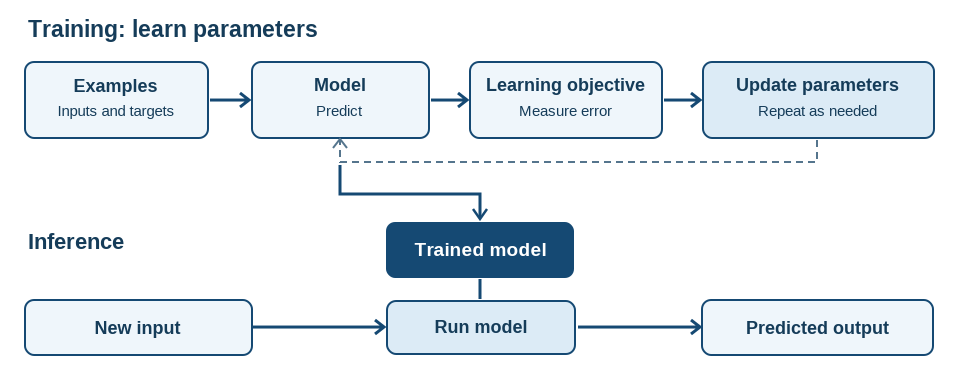
Does an AI model learn from every new request?
Usually, no. For most deployed machine-learning services, the model’s parameters are fixed during each inference request. A chat application may retain conversation history or retrieve documents, but those actions do not by themselves update the underlying model weights.
Some systems support online learning, periodic retraining, fine-tuning, or other forms of adaptation. When adaptation is enabled, it is a specific design choice with its own data handling, validation, and safety requirements, not an automatic property of every AI system.
How a machine-learning model is trained
The details differ across learning paradigms, but supervised learning offers a clear introduction to the training process.
1. Define the task and objective
Specify what the model should predict, which information will be available at prediction time, and how success will be measured. A problem framed poorly cannot be repaired simply by choosing a larger model.
2. Collect and prepare data
Obtain representative examples, handle missing or invalid records, select relevant features, and check the reliability of labels. Prevent information that would not be available at inference time from leaking into training.
3. Separate data for development and evaluation
A common arrangement uses three datasets:
- Training set: Used to fit the model’s learnable parameters.
- Validation set: Used to compare candidate models, tune hyperparameters, and make development decisions.
- Test set: Reserved for an estimate of performance on unseen examples after model selection.
The split must fit the problem. Time-series forecasting, for example, often requires chronological separation rather than random mixing of past and future observations.
4. Choose a model and training configuration
Select a suitable model family, how its inputs are represented, and its learning configuration. This includes hyperparameters such as regularization strength or learning rate, depending on the algorithm.
5. Make predictions and measure a learning objective
For a supervised prediction problem, the model produces for each training input. A loss function assigns a numerical cost to differences between predictions and targets. A lower loss generally indicates a better fit to that objective, but it does not guarantee better performance in the real world.
For example, a simple squared-error loss for one numerical prediction is:
Here is the observed target and is the prediction.
6. Adjust parameters
A learning algorithm updates parameters to improve the chosen objective. In gradient-based learning, a simplified update is:
In this expression, is the current parameter vector, is the learning rate, and is the gradient of the loss with respect to those parameters. Other model families use different fitting procedures, so gradient descent is not required for all machine-learning algorithms.
7. Validate, test, and prepare for use
Assess the model on data not used to fit it, compare it with an appropriate baseline, investigate important errors, and decide whether it is suitable for its intended application. Once selected, save the trained model and the preprocessing information needed to use it consistently.
A learning process may also include repeated experiments, retraining, or tuning before an acceptable system is ready. These stages lead into Model Training, Overfitting, and Generalization and Evaluating Machine Learning Models.
Worked example: Estimating daily electricity use
Consider a deliberately simplified building in which an engineer wants to predict daily electricity consumption using only the number of hours an air conditioner operates.
The following is illustrative data, not measurements from a real building:
| Air-conditioner use, (hours) | Daily electricity use, (kWh) |
|---|---|
| 0 | 5 |
| 2 | 9 |
| 4 | 13 |
| 6 | 17 |
A linear model represents the relationship as:
Here is the learned weight (slope), and is the learned bias (intercept). For this simple dataset, the matching values are:
So the model is:
During training, the procedure uses the recorded examples to identify suitable values of and . During inference, the saved model can estimate consumption for an input it has not seen, such as three hours of air-conditioner use:
The inference step computes 11 kWh. It does not need to repeat model training to answer this query.
Python example: Training once, predicting later
This compact example uses scikit-learn. The fitted coefficients depend on the small illustrative dataset, so it should not be treated as a realistic energy forecasting system.
import numpy as np
from sklearn.linear_model import LinearRegression

# Historical examples: hours of AC use -> daily electricity in kWh.
X_train = np.array([[0], [2], [4], [6]])
y_train = np.array([5, 9, 13, 17])

# Training: fit model parameters using the examples.
model = LinearRegression()
model.fit(X_train, y_train)

# Inference: use the fitted model on a new input.
new_input = np.array([[3]])
predicted_kwh = model.predict(new_input)[0]

print(f"Estimated usage: {predicted_kwh:.1f} kWh")
Expected output:
Estimated usage: 11.0 kWhA real forecasting model would need more relevant features, representative data, suitable time-based evaluation, and an assessment of uncertainty. The example is designed to demonstrate the difference between fitting parameters and using them.
What happens during inference?
When a model is deployed inside an application, inference often follows a pipeline:
- Receive input. A user submits a request or another software component supplies data.
- Validate input. The application checks types, allowed ranges, required fields, and access permissions.
- Apply preprocessing. Values are cleaned, encoded, scaled, or tokenized as required by the model.
- Run the model. The model processes the prepared input using its existing learned parameters or represented knowledge.
- Interpret the output. The application may turn scores into decisions, format generated content, or apply constraints.
- Return and monitor. The application supplies the result and, where appropriate, records errors, latency, or feedback for later evaluation.
The training and inference pipelines must agree about the meaning of inputs. If a model was trained using temperatures measured in degrees Celsius but a production application supplies Fahrenheit values without conversion, predictions may be wrong even though the model runs without a software error.
Inference output is not always a final decision
For example, a spam classifier might return a score of 0.82. That score alone does not specify what the email application must do. The surrounding system might compare it with a threshold, move the message to a spam folder, request review, or leave the message unchanged.
Similarly, a language model can generate text, but the application remains responsible for handling permissions, retrieving trustworthy data, checking output constraints, and determining whether the text should be shown or used to take further action.
Different kinds of outputs
The meaning of inference depends on the task being performed.
| Task | Example input | Example model output |
|---|---|---|
| Classification | Email text | Scores for “spam” and “not spam” |
| Regression | Building measurements | Predicted electricity use in kWh |
| Ranking | A search query and candidate documents | Relevance scores used to order results |
| Generation | A text prompt | Generated text or another content representation |
| Perception | A camera image | Identified objects or regions in an image |
| Decision support | A set of possible actions and current conditions | A recommended action or estimated value for each action |
An application may combine several models or AI methods. For instance, an educational assistant might retrieve documents, rerank candidate passages, and then generate an answer with a language model. Each component serves a different purpose within the same system.
Evaluating the model and evaluating the system
Model evaluation asks whether the model performs its intended task well on representative data. The relevant measures depend on the task: a regression model might use mean absolute error, while a classifier might use precision, recall, or other classification measures.
System evaluation asks whether the complete application works reliably and appropriately. This includes correct input handling, secure access, user-facing behavior, latency, operating cost, and how failures are managed.
A useful distinction is:
| Level | Example evaluation question |
|---|---|
| Training | Is the learning procedure improving its objective? |
| Validation | Which model and configuration should be selected? |
| Testing | How well does the chosen model generalize to held-out examples? |
| Application testing | Does the service supply the correct input and interpret outputs correctly? |
| Production monitoring | Are quality, input patterns, latency, or failure rates changing over time? |
A model can perform well on a historical test dataset and still struggle after deployment. New input patterns, incorrect preprocessing, changed real-world conditions, and unexpected user behavior can all reduce system reliability.
Common misconceptions
“An AI model and an AI system are the same thing”
A model is generally one component of a system. The system also includes input handling, surrounding software, interfaces, controls, and operational processes. Some AI systems use several models, and some use explicit reasoning techniques without trained ML models.
“All AI systems must be trained on data”
Learning-based AI uses training or other learning processes. Symbolic systems may instead operate using explicitly represented rules, knowledge, and search procedures. Many practical applications combine both approaches.
“Inference means the model is learning”
Inference means producing an output using an existing model. Parameter learning requires a separate learning process or an explicitly designed adaptive mechanism. Conversation history and retrieved documents can change the context supplied to a model without changing the model itself.
“Low training error means the model is accurate”
Good performance on the data used for fitting is not enough. A model may memorize patterns that do not generalize to new observations. Independent evaluation helps reveal this problem.
“The output of a model is automatically trustworthy”
Predictions may be wrong, generated statements may be unsupported, and scores may be misinterpreted. The system must evaluate outputs according to their intended use and the consequences of error.
Practical limits and engineering considerations
- Data quality and coverage: Poor, biased, outdated, or unrepresentative data can produce unreliable learned behavior.
- Generalization: A learned relationship may not hold outside the conditions represented in the training data.
- Input consistency: Training and inference must use compatible data definitions and preprocessing.
- Computational resources: Training and inference have different hardware, memory, latency, and cost requirements; their exact demands depend on the model and workload.
- Human oversight: Where errors matter, an application may need review processes, confidence checks, or restrictions on automatic actions.
- Maintenance: Models and applications require versioning, testing, monitoring, and occasionally replacement or retraining.
These concerns do not make AI unusable. They explain why designing a dependable AI system requires more than selecting a model.
Related concepts and next reading
This article builds on What Is Artificial Intelligence? and sits within the AI Knowledge Map.
To continue studying the foundations, see Symbolic AI and Learning-Based AI. For the mathematical and implementation details, continue with Optimization and Gradient Descent, Model Training, Overfitting, and Generalization, and Evaluating Machine Learning Models. For the architecture of complete applications, see AI Application Architecture.
Availability note: Some linked PlainCS articles are planned in the knowledge map and may not yet be published.
References
- ISO/IEC 22989:2022 — Artificial intelligence concepts and terminology. Technical terminology reference.
- OECD AI Principles — AI system definition. International policy definition and related concepts.
- Google Machine Learning Crash Course. Learning, loss, regression, generalization, and evaluation.
- IBM — What Is Model Training?. Explanation of model training, parameters, hyperparameters, and training workflows.
Related articles in
- AI Agents and Tool-Using Workflows — Learn agent goals, tool invocation, planning, state, permissions, and how to evaluate multi-step AI workflows.
- AI Development Tools: Git, Jupyter, and APIs — Learn how Git, Jupyter notebooks, Python environments, and APIs fit together in reproducible, secure artificial intelligence workflows.
- How AI Is Changing Theoretical Computer Science — AI is beginning to help researchers explore algorithms, mathematical structures, and formal proofs. Here is what it can do, what still needs human judgment, and why verification matters.