When your email service filters spam, a navigation app chooses a route, or a phone turns speech into text, software is doing more than simply displaying stored information. It is interpreting inputs and producing a result. Some of these systems use artificial intelligence (AI).
The basic idea is straightforward: AI is about building computational systems that can perform tasks involving capabilities such as perception, reasoning, learning, prediction, planning, or language use. Different systems achieve these capabilities in different ways. An AI system does not need to think like a human or be conscious to be useful.
To understand the field, start with a familiar example, then examine the technical definitions and the methods behind the result.
Start with an example: Recognizing spam email
Imagine receiving this email:
Congratulations! You have won a prize. Click this link to claim it now.
An email service might label it spam. How could the software decide?
One approach is to write explicit rules. For example, mark messages containing certain phrases or suspicious links for review. Another approach is to train a model on many messages labeled spam and not spam. The trained model can learn statistical patterns associated with each class.
A learning-based spam filter typically follows two different processes:
- Training: Use labeled examples to adjust the model so it can distinguish spam from legitimate email.
- Inference: Give the trained model a new message and ask it to estimate whether that message is spam.
The service may then apply a threshold and move the email to a spam folder. It must still handle mistakes. A legitimate email incorrectly classified as spam is a false positive; spam incorrectly allowed through is a false negative.
This one example introduces several important ideas: a real-world task, input data, a computational model or rules, an output, and a way to evaluate whether the result is useful.
What does artificial intelligence mean?
In technical use, artificial intelligence refers to the discipline of researching and developing mechanisms and applications of AI systems. This field-oriented description follows the framing of ISO/IEC 22989:2022, an international standard covering AI concepts and terminology.
An AI system is an engineered system that uses inputs to infer how to generate outputs such as predictions, recommendations, content, or decisions for explicit or implicit objectives. The OECD AI system definition also notes that different systems have different degrees of autonomy and ability to adapt after deployment.
These are related terms, but they are not interchangeable:
| Term | Meaning | Example |
|---|---|---|
| Artificial intelligence | The broad field concerned with AI methods and systems | Research on automated reasoning or machine learning |
| AI system | A working combination of components that uses AI to produce results | An email spam-filtering service |
| Model | A computational representation or function used to map inputs to results | A trained email classifier |
| Algorithm | A defined computational procedure | An algorithm for fitting a classifier or searching possible solutions |
| Data | Information used as input, for learning, or for evaluation | Email messages and their labels |
Important: These are educational paraphrases, not quotations of the standards. AI is a broad field, and its boundaries cannot be reduced to one everyday example.
How does an AI system work?
An AI application often takes input, processes it, applies an AI method, and produces an output. The method might involve rules, search, a learned statistical model, or a combination.
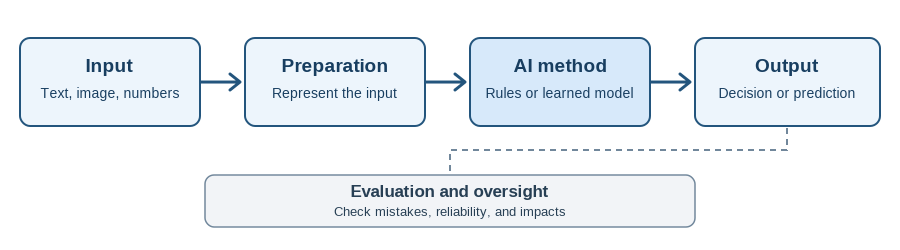
Using the spam-filter example:
- Input: The new email contains words, links, and other information.
- Preparation: The service represents relevant parts of the message in a form its model can process.
- AI method: A trained classifier estimates a spam score.
- Output: The application chooses a label or folder based on its policy.
- Evaluation: Developers measure errors on representative messages and monitor how the system performs.
The classifier and the surrounding application serve different roles. A good model still needs safe integration, sensible decision thresholds, and ongoing evaluation.
Training is different from inference
A common misunderstanding is that every time an AI system produces an answer, it is learning.
Training means changing a learning model’s parameters using data and a learning procedure. Inference means using the resulting model to process a new input. Inference usually does not change the model’s learned parameters.
For example, a spam model might be trained on historical messages on one day, then classify incoming messages for weeks. Its predictions may inform later improvements, but those updates require a separate process.
Explore this distinction in AI Systems, Models, Training, and Inference.
The major approaches to AI
AI is not a single technology. Its methods differ in how they represent knowledge and produce results.
Symbolic AI: Using knowledge and reasoning
Symbolic AI works with explicit representations such as logical statements, rules, facts, and relationships. A system can apply inference rules or search possible solutions to reach a conclusion.
Consider a route-planning task. If roads are represented as connections between locations, a search algorithm can examine possible paths and identify one that satisfies a chosen objective, such as minimum travel cost.
Symbolic techniques can be easier to inspect when the knowledge and reasoning steps are explicit. However, representing a complicated, changing world entirely by hand is difficult.
Machine learning: Learning patterns from data
Machine learning (ML) develops models that improve at tasks through learning from data or experience rather than relying only on manually written rules.
A spam classifier trained on labeled messages is an example. Instead of specifying every suspicious phrase, developers provide examples from which a learning algorithm fits a model.
The quality of the result depends heavily on data quality, model design, the task, and evaluation. A model can learn misleading patterns or perform poorly on unfamiliar examples.
Deep learning: Learning with multilayer neural networks
Deep learning (DL) is a branch of machine learning based on neural networks with multiple computational layers. These networks can learn complex representations from data.
For example, an image-classification network may learn patterns that help distinguish cats from dogs without a developer manually defining every relevant shape or texture. Deep learning is especially important in modern language, image, and speech systems, though it can require substantial data and computing resources.
Generative AI: Producing content
Generative AI refers to AI systems designed to generate content such as text, images, audio, video, or code. Many modern generative models use deep learning, but generative describes what the model is designed to do rather than one exclusive architecture.
A text-generation model, for instance, can produce an answer from a prompt. Producing fluent text does not guarantee that each claim is true.
How these ideas connect
Machine learning is a major approach within AI, and deep learning is a branch of machine learning. Generative AI overlaps these areas rather than fitting neatly as a separate rung in every hierarchy. Symbolic methods can also be combined with learned models.
| Approach | Main idea | Example |
|---|---|---|
| Symbolic AI | Represent knowledge and use explicit reasoning or search | Rule-based diagnosis support or route planning |
| Machine learning | Learn useful patterns from data | Spam prediction |
| Deep learning | Learn representations using multilayer neural networks | Image recognition |
| Generative AI | Generate new content | Drafting text or generating images |
Read Symbolic AI and Learning-Based AI for a deeper comparison.
AI is broader than chatbots
Chatbots and large language models are visible applications of AI, but the broader field includes many other kinds of problems.
| Area | Typical problem | Example output |
|---|---|---|
| Natural language processing | Work with human language | A translated sentence |
| Computer vision | Interpret images and video | A detected object |
| Speech and audio AI | Process spoken language and sound | A transcript |
| Recommendation systems | Estimate which items may be relevant | A ranked list of videos |
| Robotics | Select and execute actions in a physical environment | A movement plan |
| Search and planning | Find solutions or action sequences | A route through a map |
| Predictive machine learning | Estimate outcomes from available information | An estimated delivery delay |
These are application domains and problem types, not always independent branches. For instance, a robot might use computer vision for perception, machine learning to recognize objects, and planning algorithms to choose actions.
AI versus conventional programming
Both AI and conventional software run on computers and use algorithms. The difference is not that one follows instructions while the other does not. All software executes computational procedures. The difference is often how the system’s behavior is specified.
In a straightforward program, developers may directly specify the calculation:
price = 200
sales_tax_rate = 0.05
total = price * (1 + sales_tax_rate)
print(total)  # 210.0
The output follows a known formula. There is no need to learn a pattern from examples.
In a learning-based AI approach, developers may provide examples of input-output relationships, choose a model, and use a training algorithm to fit its parameters. The resulting model then estimates outputs for new inputs.
Neither approach is automatically better. If a task can be solved exactly and reliably using a formula, database query, or ordinary program, adding machine learning may make it more complicated without improving it.
Practical rule: Start with the problem, not with the desire to use AI.
What AI can do, and where it struggles
AI systems can recognize patterns in large datasets, automate narrowly defined decisions, assist with searching and summarizing information, analyze images and audio, and generate useful drafts or predictions.
But ability in one task does not imply general reliability. Important limitations include:
- Errors and hallucinations: Generative systems can produce plausible but incorrect claims.
- Bias from data or design: Predictions may reproduce misleading or unfair patterns.
- Distribution shift: Performance can deteriorate when real-world inputs differ from development data.
- Limited context: A system may lack relevant facts, history, or current information.
- Security and privacy risks: Sensitive data and tool access require careful protection.
- Overconfidence: A confident-looking answer is not necessarily a correct one.
Why evaluation matters
Return to spam detection. A system that labels every message as not spam might seem successful if almost all received messages are legitimate. But it would fail to detect the messages that matter.
That is why developers examine the actual task, suitable metrics, representative test examples, and the consequences of incorrect outputs. They may measure precision (how many flagged messages really are spam) and recall (how many of the spam messages were detected).
Evaluation should account for real-world use, not just an impressive number in a demonstration. See Evaluating Machine Learning Models.
When should a problem use AI?
Before selecting an AI technique, ask:
- What is the task? Is the output a label, a number, a recommendation, content, or an action?
- Could a conventional solution work? A fixed rule or algorithm may be simpler and more reliable.
- What data or knowledge is available? Can it support a useful method?
- How will success be measured? What errors matter most?
- What constraints apply? Consider privacy, security, cost, latency, and human oversight.
For example, calculating a sales tax from a fixed rate needs a formula. Classifying millions of varied messages as spam can benefit from a trained model. A system that must satisfy strict business rules while interpreting messy documents might use both conventional logic and AI.
This process is called problem formulation, explored in How to Formulate an AI Problem.
Check your understanding
- Is artificial intelligence the same thing as machine learning? Explain why or why not.
- What is the difference between an AI system and a trained model?
- In the spam-filter example, what happens during training, and what happens during inference?
- Give one task that probably needs no machine learning and one that might benefit from it.
- Why must an AI system be evaluated even when its outputs appear convincing?
Show suggested answers
- No. AI is the broader discipline; machine learning is one important approach within it.
- A model is a computational component. A complete system also includes input handling, application logic, outputs, evaluation, and sometimes interfaces or tools.
- Training adjusts the model using examples. Inference applies the trained model to a new message.
- A fixed tax calculation needs a formula; classifying varied incoming emails can benefit from machine learning.
- Plausible outputs can still be incorrect, biased, unsafe, or unreliable on unfamiliar inputs.
Related concepts and next steps
- AI Knowledge Map: The broader study sequence and connected topics.
- AI Systems, Models, Training, and Inference: The components and lifecycle of an AI system.
- Symbolic AI and Learning-Based AI: Two major approaches and how they work together.
- Machine Learning Paradigms: Different ways models learn.
- Neural Network Fundamentals: The building blocks of deep learning.
- Generative AI and Model Families: How generative approaches differ.
References
- ISO/IEC 22989:2022, Artificial intelligence concepts and terminology. International terminology reference.
- OECD AI Principles. Definitions and principles for AI systems.
- NIST AI Risk Management Framework. Principles for evaluating and managing AI risks.
- Google Machine Learning Crash Course. Introductory explanations and exercises for machine learning concepts.
Related articles in
- AI Agents and Tool-Using Workflows — Learn agent goals, tool invocation, planning, state, permissions, and how to evaluate multi-step AI workflows.
- AI Development Tools: Git, Jupyter, and APIs — Learn how Git, Jupyter notebooks, Python environments, and APIs fit together in reproducible, secure artificial intelligence workflows.
- How AI Is Changing Theoretical Computer Science — AI is beginning to help researchers explore algorithms, mathematical structures, and formal proofs. Here is what it can do, what still needs human judgment, and why verification matters.