Artificial intelligence is a broad field of computer science. It includes systems that reason with explicit knowledge, systems that learn patterns from data, and systems that combine multiple approaches to perceive, predict, generate, plan, or act.
This AI Knowledge Map organizes the minimum body of knowledge needed to understand the field in breadth. Its purpose is not to turn every reader into a specialist in every branch. It provides a connected foundation for understanding how AI systems work, choosing appropriate techniques, building AI-powered software, and progressively learning to train and evaluate models.
The map has 14 knowledge areas and 73 linked explanatory articles. Related concepts share articles where that makes the explanation clearer. You can read the subjects in learning order or use this page as a reference map.
Reading note: Every topic below links to a dedicated Plain CS article. Read them in learning order or jump to the subject you need.
Understanding the field
AI, ML, deep learning, and generative AI
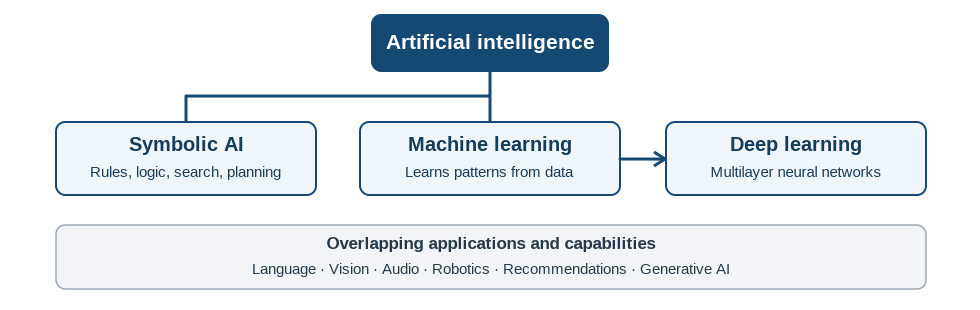
Artificial intelligence (AI) is the broader discipline concerned with the development of AI systems. The term does not describe one algorithm or one kind of software.
Machine learning (ML) is an approach within AI in which models learn patterns from data. Deep learning (DL) is a subfield of ML based on neural networks with multiple computational layers. Generative AI describes systems designed to produce content such as text, images, audio, or video; many modern examples use deep learning, but generation is a capability or modeling objective, not a separate step in a universal AI hierarchy.
Symbolic AI represents knowledge and reasoning with explicit structures such as rules, logic, and search. Applications such as robotics, natural language processing, and computer vision may use symbolic methods, learning-based methods, or both.
Essential vocabulary
| Concept | Working definition |
|---|---|
| AI system | An engineered system that produces outputs such as predictions, recommendations, decisions, or content for defined objectives. |
| Algorithm | A finite, well-defined procedure for carrying out a computation or solving a problem. |
| Data | Recorded observations or information processed by a computing system. |
| Dataset | An organized collection of data for analysis, learning, or evaluation. |
| Model | A mathematical or computational representation of patterns, relationships, or processes. |
| Feature | An individual input variable used by a model. |
| Parameter | A value learned or adjusted during model training. |
| Hyperparameter | A configuration value chosen outside the parameter-learning process. |
| Training | The process of adjusting learnable model parameters using data. |
| Inference | Using an existing model to produce an output for a new input. |
| Neural network | A model made of interconnected computational units with learnable parameters. |
| Generative AI | AI designed to produce new content, including text, images, audio, or video. |
These are concise working definitions, not verbatim quotations from a terminology standard. For formal vocabulary, consult ISO/IEC 22989.
Prerequisites and learning paths
You do not need to master all of computer science or mathematics before beginning AI. However, different goals require different depths of study.
| Foundation | Minimum understanding | Where it becomes useful |
|---|---|---|
| Programming and algorithms | Python, data structures, functions, problem solving, basic complexity | Data processing, experiments, and AI products |
| Linear algebra | Vectors, matrices, dot products, matrix operations | Tensors, embeddings, neural network computation |
| Calculus and optimization | Derivatives, gradients, chain rule, loss minimization | Gradient descent and backpropagation |
| Probability and statistics | Conditional probability, distributions, estimation, variance, sampling | Classification, uncertainty, evaluation |
| Software engineering | APIs, testing, version control, databases, deployment basics | Reliable AI application development |
There are two valid paths through this map:
- Model-building path: Mathematics and data → machine learning → neural networks → deep learning → training and model evaluation.
- Application-building path: Programming and APIs → using existing models → prompting and retrieval → agents and architecture → deployment, monitoring, and security.
These paths reinforce one another. Building useful applications with existing models does not require training a large model first.
The 14 knowledge areas
Each area below introduces a part of the field and links to its explanatory articles. The order supports a beginner-friendly progression, but some areas can be studied in parallel.
01. AI foundations and terminology
Begin with the meaning of AI, the difference between a system and a model, and the main approaches to building intelligent systems. Symbolic reasoning and learning-based methods are complementary, not competing definitions of AI.
- What Is Artificial Intelligence?
- AI Systems, Models, Training, and Inference
- Symbolic AI and Learning-Based AI
02. Mathematical foundations
Mathematics supplies the language for representing data, quantifying uncertainty, and improving model behavior. Focus first on meaning and practical use, then on formal derivations.
- Vectors and Matrices
- Vector and Matrix Operations
- Derivatives, Gradients, and the Chain Rule
- Probability and Bayes’ Theorem
- Descriptive and Inferential Statistics
- Optimization and Gradient Descent
- Entropy, Cross-Entropy, and KL Divergence
03. Programming and computational foundations
AI work depends on ordinary computer science: programming, algorithms, data structures, numerical computing, APIs, and disciplined software development.
- Python for Artificial Intelligence
- NumPy, Arrays, and Tensors
- Data Analysis with Pandas and SQL
- AI Development Tools: Git, Jupyter, and APIs
04. Data engineering and preparation
Learning systems depend on the data they receive. Collection choices, transformations, labels, splits, and leakage prevention often matter as much as model choice.
- Data Types and Data Collection for AI
- Data Cleaning and Preprocessing
- Feature Engineering, Encoding, and Scaling
- Data Splitting, Labeling, and Leakage
05. AI problem formulation
Turn a real-world need into a precise input, output, objective, and evaluation criterion before choosing a model. Sometimes a conventional algorithm is the correct solution.
06. Machine learning
Machine learning builds models from data. Understand learning paradigms, representative algorithms, the training cycle, overfitting, generalization, and trustworthy evaluation.
- Machine Learning Paradigms
- Linear and Logistic Regression
- Decision Trees, Random Forests, and Boosting
- Support Vector Machines and Nearest Neighbors
- Clustering and K-Means
- Dimensionality Reduction and PCA
- Naive Bayes and Probabilistic Classification
- Model Training, Overfitting, and Generalization
- Evaluating Machine Learning Models
07. Deep learning and neural networks
Deep learning uses multilayer neural networks to learn representations from data. Study the computation inside a network before moving to complex architectures and frameworks.
- Neural Networks: Neurons, Layers, Weights, and Biases
- Forward Propagation and Backpropagation
- Training Neural Networks: Loss, Optimizers, and Regularization
- Convolutional and Recurrent Neural Networks
- Deep Learning with PyTorch
08. AI application domains
Application fields describe the problems being solved, not necessarily the model architecture. NLP, vision, speech, recommendations, and retrieval can draw on several AI approaches.
- Natural Language Processing Fundamentals
- Text Processing, Tokenization, and Embeddings
- Computer Vision Fundamentals
- Image Classification, Detection, and Segmentation
- Speech and Audio AI
- Recommendation Systems
- Information Retrieval and Search
09. Generative AI and large language models
Generative AI focuses on producing new content. Learn the major generative model families, how Transformers work, and the lifecycle and limitations of language models.
- Generative AI and Generative Model Families
- The Transformer Architecture
- Attention, Self-Attention, and Multi-Head Attention
- Large Language Models: Foundations and Capabilities
- LLM Pretraining, Fine-Tuning, and Alignment
- LLM Inference, Decoding, and Sampling
- Multimodal Artificial Intelligence
10. AI application engineering
Useful AI software often integrates existing models instead of training a new one. Learn how prompts, APIs, retrieval, structured outputs, and bounded agent workflows fit into applications.
- Integrating AI Models with APIs
- Prompt Engineering for AI Applications
- Structured Outputs, Function Calling, and Tools
- Embeddings and Vector Search
- Retrieval-Augmented Generation
- RAG: Chunking, Indexing, and Reranking
- Prompting vs. RAG vs. Fine-Tuning
- AI Agents and Tool-Using Workflows
11. AI systems and inference engineering
An AI model is only one component of a product. Real systems need services, data stores, inference infrastructure, deployment processes, performance controls, and security.
- AI Application Architecture
- Model Serving and Deployment
- Inference Optimization and Quantization
- GPU Compute, Latency, and Throughput
- Building Reliable AI Backends
12. MLOps and AI evaluation
Production AI requires repeatable experiments, tested releases, monitoring, and evaluation that measures more than whether an output looks plausible.
- The Machine Learning Lifecycle and MLOps
- Data, Model, and Experiment Versioning
- Monitoring, Data Drift, and Concept Drift
- Evaluating Generative AI Systems
- Evaluating RAG and AI Agents
13. AI safety, security, and governance
Reliability is an engineering concern. Understand privacy, fairness, oversight, security threats, and the limits of learned models before trusting production behavior.
- Responsible AI, Ethics, and Governance
- AI Security Threats and Defenses
- AI Limitations, Robustness, and Trustworthiness
14. Other important AI branches
The field extends beyond modern neural networks. These areas complete a broad conceptual picture and provide alternative approaches for reasoning, planning, physical interaction, and specialized data.
- Knowledge Representation and Automated Reasoning
- Search, Planning, and Decision-Making
- Reinforcement Learning and Robotics
- Causal, Graph, Time-Series, Fuzzy, and Evolutionary AI
How the knowledge areas connect
The subjects above are not isolated chapters. Several important paths show how one idea supports another:
- Vectors → embeddings → semantic retrieval → RAG. Numerical representations make it possible to compare meaning and retrieve relevant source material for an AI application.
- Derivatives → gradients → optimization → backpropagation. Calculus explains how neural networks adjust their parameters during training.
- Probability → loss functions → evaluation → uncertainty. Statistical reasoning helps quantify errors and judge whether a model’s predictions are dependable.
- Data preparation → training → generalization → monitoring. A well-performing model depends on sound input data during both development and production.
- Neural networks → attention → Transformers → language models. Modern language models build on ideas introduced in earlier deep-learning topics.
- Software engineering → APIs → retrieval → agents → production systems. Useful AI products require much more than a model that can generate an answer.
- Knowledge representation → search and planning → agents and robotics. Explicit reasoning and planning remain important alongside learning-based AI.
These relationships explain why foundational concepts deserve attention even when the immediate goal is building an AI application.
Recommended learning sequence
This application-oriented sequence preserves the foundations needed to understand the technology. Each stage represents a learning milestone, not a fixed amount of time.
| Stage | Study focus | What you should be able to do |
|---|---|---|
| 1 | AI fundamentals | Distinguish major approaches and application areas. |
| 2 | Python and numerical computing | Process data and implement basic computations. |
| 3 | Mathematical foundations | Explain the mathematical ideas behind learning. |
| 4 | Data handling | Clean, represent, and split datasets correctly. |
| 5 | Traditional machine learning | Train basic classification and regression models. |
| 6 | ML evaluation | Select metrics and recognize overfitting or leakage. |
| 7 | Neural network fundamentals | Explain layers, activations, and backpropagation. |
| 8 | Deep learning with PyTorch | Build and train a simple neural network. |
| 9 | Application domains | Recognize NLP, vision, speech, retrieval, and recommendation tasks. |
| 10 | Transformers and LLMs | Explain attention and the model lifecycle conceptually. |
| 11 | AI application engineering | Integrate a model through an API and handle its outputs. |
| 12 | RAG and embeddings | Build retrieval-backed responses over a document collection. |
| 13 | AI agents | Implement a constrained workflow with tools and checks. |
| 14 | Production engineering | Deploy, monitor, test, and optimize an AI application. |
| 15 | AI safety and security | Identify risks and design appropriate safeguards. |
Basic model-API integration and prompting can begin around stages 3–4. This is a learning sequence, not a strict dependency rule.
Levels of understanding
Not every article requires the same depth of study.
| Level | Expected competence | Examples |
|---|---|---|
| Master the foundations | Explain the idea, work through examples, implement basic versions, and recognize limitations. | Python, data preparation, ML fundamentals, neural networks, evaluation, APIs, RAG |
| Develop working knowledge | Understand how and when a technique works, integrate it, and assess its results. | Transformers, vector databases, fine-tuning, serving, agents, MLOps |
| Build awareness | Recognize the problem, terminology, methods, and likely applications. | Robotics, fuzzy logic, causal AI, evolutionary methods, advanced reinforcement learning |
The appropriate level may change with your goals. A robotics developer, for example, would need to go much deeper into control, sensors, and reinforcement learning.
Practical competency checklist
Use this list to check whether you can connect knowledge with implementation:
- Explain the differences among AI, ML, deep learning, and generative AI.
- Formulate a task and decide whether it actually requires machine learning.
- Prepare data, choose an algorithm, and evaluate a traditional ML model.
- Explain neural network computation, training, and backpropagation.
- Build a small network in PyTorch and test it on unseen data.
- Describe Transformers and how LLMs generate text.
- Integrate an existing model through an API with structured outputs.
- Build a basic embedding search or RAG application.
- Explain when prompting, RAG, or fine-tuning is suitable.
- Build a bounded tool-using AI workflow with error handling and human approval where necessary.
- Deploy and monitor an AI application using suitable quality measures.
- Identify privacy, safety, security, and reliability risks.
Further reading
These references complement the PlainCS articles and provide deeper technical material:
- ISO/IEC 22989: AI concepts and terminology, for standardized terminology.
- Google Machine Learning Crash Course, for introductory ML lessons and exercises.
- Deep Learning, for mathematical and theoretical foundations.
- PyTorch Tutorials, for implementing and training neural networks.
- Hugging Face Learn, for language models, Transformers, and related tooling.
- NIST AI Risk Management Framework, for AI risk and trustworthiness.
The goal of this map is breadth with meaningful connections. Begin with the fundamentals, follow a path that matches your goals, and return to the map as concepts become relevant in real systems.
Related articles in
- AI Agents and Tool-Using Workflows — Learn agent goals, tool invocation, planning, state, permissions, and how to evaluate multi-step AI workflows.
- AI Development Tools: Git, Jupyter, and APIs — Learn how Git, Jupyter notebooks, Python environments, and APIs fit together in reproducible, secure artificial intelligence workflows.
- How AI Is Changing Theoretical Computer Science — AI is beginning to help researchers explore algorithms, mathematical structures, and formal proofs. Here is what it can do, what still needs human judgment, and why verification matters.