An AI model API is an interface through which software sends input to an AI model or model-serving system and receives a result. Instead of implementing and training a model inside every application, a developer can call an existing model through a defined interface.
A web application might send a document and a question to a language model, receive an answer, and display it to the user. A factory system might send sensor values to a prediction endpoint and receive an anomaly score. Both use model APIs, although their inputs, outputs, and operational requirements differ.
API integration is an engineering task, not a training technique. The application must still handle authentication, data validation, authorization, errors, latency, privacy, costs, and the reliability of model outputs.
Start with an example: a study assistant
A study app receives a question, checks that the user is authorized, selects permitted course material, and sends a request to an AI model endpoint. The endpoint returns a response, but the app still needs to validate the result, enforce limits, handle errors, and decide what to show. Calling a model is one component of a product, not the whole product.
1. Model, inference service, and API
These terms refer to different components.
| Component | Definition | Responsibility |
|---|---|---|
| Model | A learned computational system with parameters | Computes predictions or generated outputs |
| Inference | The process of running a model on input | Produces an output using learned parameters |
| Model server | Software that loads and executes the model | Manages requests, execution, and resources |
| API | A defined interface to software functionality | Specifies how clients send requests and receive results |
| Client application | Software calling the API | Collects input and uses the returned result |
An API endpoint may expose one model, route requests among several models, or perform additional operations such as moderation, retrieval, or preprocessing. Consequently, an API response is not necessarily the raw output of a single model.
2. How a model API fits into an application
A common architecture puts an application backend between the user-facing client and the model service.
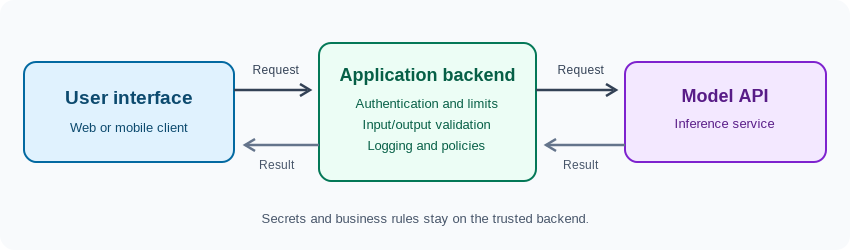
The sequence is:
- The client submits an authorized request to the application backend.
- The backend validates input, checks permissions, and selects a model.
- The backend constructs an API request and includes credentials securely.
- The model service runs inference and sends back a response or error.
- The backend checks the response and applies any additional rules.
- The application returns an appropriate result to the client.
Some trusted desktop or internal systems can call a model server directly. Public browser and mobile applications generally should not embed private API credentials, because users can inspect their distributed code and network traffic.
3. Hosted models versus self-hosted models
Hosted inference uses a provider-operated service. The provider typically manages model deployment, inference hardware, and service operations.
Self-hosted inference runs a model under the application’s own operational control, for example on an organization’s server or a local device. It still can expose an HTTP API.
| Consideration | Hosted API | Self-hosted model API |
|---|---|---|
| Initial setup | Often simpler | Requires model serving and infrastructure setup |
| Model maintenance | Usually handled by provider | Responsibility of deploying organization |
| Hardware requirements | Mostly external to application | CPU/GPU memory and capacity must be planned |
| Cost structure | Often usage-based | Hardware, hosting, power, and operations |
| Data governance | Depends on provider contracts and settings | Greater operational control, but not automatic compliance |
| Customization | Depends on provider capabilities | Depends on accessible model and serving stack |
| Scaling | Provider-dependent quotas and capacity | Requires capacity planning and scaling systems |
Neither option is universally better. Selection depends on the model’s capabilities, data restrictions, budget, service requirements, and team expertise.
4. Understand the API contract
An API contract specifies what callers must send and what they can expect to receive. With HTTP-based APIs, important elements include:
- Endpoint: URL for the requested operation.
- HTTP method: Commonly
POSTfor inference requests containing a body. - Headers: Metadata such as content type and authentication credentials.
- Request body: JSON, binary data, or multipart input defined by the API.
- Response body: Prediction, generated content, metadata, or error information.
- Status code: Indicates transport-level or request-level success and failure.
- Timeout: Maximum time a client permits the request to take.
A simplified illustrative classification request might look like this:
POST /v1/classify HTTP/1.1
Host: model.example
Authorization: Bearer YOUR_TOKEN
Content-Type: application/json

{"text": "Your package has shipped."}
And the service might respond:
{
  "label": "transactional",
  "confidence": 0.96,
  "model_version": "example-v1"
}
These examples demonstrate a possible contract; they are not a specification for any particular provider. Real APIs differ in their endpoint names, authentication methods, parameter names, and response schemas. A returned confidence score should not automatically be treated as a calibrated probability.
5. Inputs, prompts, and structured data
Different models require different inputs:
| Model type | Example input | Example output |
|---|---|---|
| Text classifier | Text string | Class label or scores |
| Embedding model | Text or another supported modality | Numerical vector |
| Image classifier | Image bytes or supported image reference | Class probabilities or scores |
| Speech recognizer | Audio signal | Transcript |
| Generative language model | Messages or prompt | Generated text or structured output |
For language models, the prompt contains instructions and context for generation. Model providers may distinguish between higher-priority application instructions and user-supplied content. Do not assume all providers use identical role structures.
Keep untrusted source text, retrieved documents, and user messages distinguishable from application instructions. Treat model output as untrusted application data until validated.
6. A practical Python API client
The following example uses Python’s standard library and a generic JSON inference endpoint. It demonstrates request construction, secret handling, timeouts, response parsing, and basic errors. It is intended as an adaptable pattern, not code that will work unchanged against every commercial model API.
import json
import os
from urllib.error import HTTPError, URLError
from urllib.request import Request, urlopen


def classify_text(text: str) -> dict:
    if not text.strip():
        raise ValueError("Text must not be empty")

    token = os.environ.get("MODEL_API_TOKEN")
    endpoint = os.environ.get("MODEL_API_ENDPOINT")
    if not token or not endpoint:
        raise RuntimeError("Configure MODEL_API_TOKEN and MODEL_API_ENDPOINT")

    body = json.dumps({"text": text}).encode("utf-8")
    request = Request(
        endpoint,
        data=body,
        headers={
            "Authorization": f"Bearer {token}",
            "Content-Type": "application/json",
            "Accept": "application/json",
        },
        method="POST",
    )

    try:
        with urlopen(request, timeout=20) as response:
            result = json.load(response)
    except HTTPError as exc:
        # Avoid logging request bodies, secrets, or sensitive responses.
        raise RuntimeError(f"Model API returned HTTP {exc.code}") from exc
    except URLError as exc:
        raise RuntimeError("Model API is unreachable") from exc

    if not isinstance(result, dict) or not isinstance(result.get("label"), str):
        raise ValueError("Unexpected model response format")

    return result


if __name__ == "__main__":
    output = classify_text("Your package has shipped.")
    print(output["label"])
Before running this code, set the environment variables to a trusted provider endpoint and your own secret token. Production services should additionally restrict allowed endpoints, validate response size and full schema, and use a maintained HTTP client with connection pooling where appropriate.
Why the validation matters
The code verifies that the response is an object containing a string label. This is a minimal check. In a real application, define permissible label values, required fields, numerical ranges, length limits, and behavior for unexpected results. A successful HTTP response does not prove the prediction is correct or the content is safe.
7. Structured outputs and schema validation
Generated prose is flexible but difficult for downstream programs to parse reliably. Structured output asks the model or serving system for a known data shape, such as a JSON object.
For example, a ticket-routing application might need:
{
  "category": "billing",
  "urgency": "medium",
  "requires_human_review": false
}
An application should validate that:
- The response is valid JSON, when JSON is required.
- Required properties exist and have the correct types.
- Values belong to supported categories or ranges.
- Additional or unexpected fields follow application policy.
- Sensitive actions still require authorization and appropriate human approval.
Provider-supported constrained decoding can improve structural reliability, but schema-valid output does not imply factual accuracy or correct decisions.
8. Streaming versus ordinary responses
A normal request returns a complete result once inference has finished. Streaming delivers parts of a response progressively, which can make long text generation feel more responsive.
| Mode | Advantage | Trade-off |
|---|---|---|
| Complete response | Easier to validate before showing it | User waits for the full result |
| Streaming response | Earlier visible output | Must handle partial content, disconnections, and incremental validation |
| Asynchronous job | Supports long-running workloads | Requires job state, polling or callbacks, and cancellation rules |
A streaming application must handle incomplete chunks. A partial JSON object is not necessarily valid JSON yet. For safety-sensitive or action-triggering results, prefer validating the complete output before taking consequential action.
Streaming usually changes the delivery pattern, not the fundamental model capability.
9. Authentication, authorization, and privacy
Authentication establishes the identity of a client or service. Authorization determines what an authenticated identity is permitted to do. AI integrations need both.
Key practices include:
- Store provider credentials in server-side secrets management or environment configuration, not frontend code or source repositories.
- Authenticate application users separately from the provider’s API token.
- Apply access controls before transmitting protected data to a model endpoint.
- Limit the data sent to what the task actually needs.
- Consider provider retention, processing locations, contracts, and organizational privacy requirements.
- Restrict which model tools or downstream functions a user or model may invoke.
- Avoid logging full prompts and outputs when they contain personal or confidential information.
- Rotate compromised credentials and monitor for anomalous usage.
Prompt injection is also a security concern. Text from a webpage, document, or user may attempt to instruct a model to ignore its intended task. Treat such material as task data rather than a trusted instruction source, and keep authorization checks outside the model.
10. Reliability: failures, timeouts, and retries
Model API calls can fail because of invalid requests, authentication issues, rate limits, unavailable services, network interruptions, or long-running inference.
| Situation | Typical response from application |
|---|---|
| Invalid input | Reject with a useful validation message |
| Unauthorized request | Stop and correct credentials or permissions |
| Rate limit | Reduce request rate; retry only when permitted |
| Temporary service failure | Retry with bounded exponential backoff and jitter |
| Timeout | Report or recover from an unknown completion state |
| Invalid model output | Validate, optionally retry, or request human review |
Retries must be bounded. Sending a request again can generate another billable inference, duplicate a non-idempotent action, or return a different result. Where supported, use idempotency keys and verify a provider’s documented retry behavior. Respect Retry-After headers when present.
A reliable integration also uses concurrency limits, circuit breakers where appropriate, observable request identifiers, and fallback behavior when the model is unavailable.
11. Latency, throughput, and cost
Latency is the elapsed time for a request. Throughput measures how much work a service can handle over time. A model may provide good results in isolation while becoming slow under many concurrent requests.
For text generation, useful measurements include:
- Time to first token or first visible output.
- End-to-end response latency.
- Input and output token counts, when provided.
- Tokens generated per second.
- Request success and failure rates.
- Concurrent request count and rate-limit events.
Depending on a provider’s billing model, cost may depend on input tokens, output tokens, model choice, cached input, media processed, or compute time. A simple illustrative token-based cost calculation is:
Here, and are the hypothetical prices per million input and output tokens. Actual billing may include additional terms and different units.
Improve efficiency by selecting an adequate model rather than automatically the largest one, minimizing unnecessary context, caching eligible results, limiting output size, and measuring quality before reducing computation.
12. Model selection and versioning
Model selection should reflect a measurable application requirement, not popularity alone. Compare candidates using representative task examples.
Important criteria include:
- Accuracy and task-specific quality.
- Supported modalities, input lengths, and output features.
- Latency, throughput, and available capacity.
- Cost under expected usage.
- Data handling and compliance requirements.
- Availability of structured outputs, tool calling, or fine-tuning if needed.
- Stability, version support, and deployment portability.
Where a service offers explicit model versions, record the chosen version and test new releases before switching production traffic. Model behavior can change with new versions, prompts, inference parameters, or upstream data.
13. Testing an AI integration
Traditional tests are necessary but insufficient because learned models may generate variable outputs.
Software contract tests
Test authentication failures, request validation, schema violations, timeouts, malformed responses, empty content, and rate-limit handling. Use a mock service so tests do not depend on live inference.
Model-quality tests
Maintain a representative set of inputs with evaluation criteria. For classifiers, measure precision, recall, or other suitable metrics. For generative tasks, assess correctness, relevance, groundedness, safety, and human-reviewed task outcomes.
End-to-end tests
Check that the complete user workflow behaves correctly: data permissions, preprocessing, inference, postprocessing, storage, and display. Include adversarial inputs and confidential-data handling where applicable.
Keep software correctness separate from model quality. A request can be transmitted and parsed correctly while the model’s answer is wrong.
14. Common integration mistakes
Calling a provider directly from a public browser with a secret key. Anyone who can access the application may extract the key. Route requests through a trusted backend unless the provider explicitly supports a secure client-side credential design.
Assuming an HTTP 200 response means the task succeeded. Check the response schema and application-level requirements.
Parsing generated text with fragile string splits. Prefer structured outputs and formal validation when downstream software needs predictable data.
Retrying every failed request immediately. Retries can worsen outages, increase cost, and duplicate operations.
Sending all available user data to the model. Data minimization and permission checks are necessary even when a provider offers strong security features.
Treating model-generated tool arguments as authorized actions. Validate parameters, identity, permissions, and consequences outside the model.
Ignoring deployment changes. A model update, prompt change, or provider configuration change can alter application behavior even when the surrounding code stays the same.
15. A practical implementation checklist
Use this checklist when adding a model API to a software project:
- Define the user task and measurable success criteria.
- Choose hosted or self-hosted inference based on requirements.
- Read the specific API’s request, authentication, and error contract.
- Keep credentials and privileged operations on a trusted backend.
- Validate inputs, outputs, permissions, and response sizes.
- Configure timeouts, rate limits, and bounded retries.
- Measure latency, quality, and cost using realistic requests.
- Test error paths and model failures, not just successful outputs.
- Record model versions and monitor changes after deployment.
- Define human review or fallback paths for important decisions.
16. Related concepts and learning path
- AI Knowledge Map locates API integration within the full AI learning sequence.
- AI Systems, Models, Training, and Inference distinguishes an AI model from its surrounding system.
- AI Development Tools: Git, Jupyter, and APIs introduces general API and development concepts.
- Large Language Models: Foundations and Capabilities explains the models commonly exposed by generative APIs.
- LLM Inference, Decoding, and Sampling explains generation controls and inference behavior.
- Prompt Engineering for AI Applications develops prompt design and testing.
- Structured Outputs, Function Calling, and Tools covers reliable programmatic interactions with generative models.
- Retrieval-Augmented Generation shows how applications combine model responses with retrieved external knowledge.
- AI Application Architecture covers the complete software system around model integration.
- Building Reliable AI Backends extends the discussion to production failure handling and operations.
17. Further reading
- HTTP Semantics (RFC 9110) — standard semantics for HTTP methods, status codes, and requests.
- OWASP API Security Top 10 — common API design and implementation risks.
- OWASP Top 10 for Large Language Model Applications — security risks relevant to applications using LLMs.
- Google Cloud Architecture Center — guidance on reliability, scaling, and service architecture.
- NIST AI Risk Management Framework — principles for evaluating and managing AI risks.
Related articles in
- AI Agents and Tool-Using Workflows — Learn agent goals, tool invocation, planning, state, permissions, and how to evaluate multi-step AI workflows.
- AI Development Tools: Git, Jupyter, and APIs — Learn how Git, Jupyter notebooks, Python environments, and APIs fit together in reproducible, secure artificial intelligence workflows.
- How AI Is Changing Theoretical Computer Science — AI is beginning to help researchers explore algorithms, mathematical structures, and formal proofs. Here is what it can do, what still needs human judgment, and why verification matters.