A large language model (LLM) is a language model with a large number of learned parameters, trained on extensive text or other suitable data to model patterns in language and perform language-related tasks. Modern generative LLMs commonly use Transformer neural networks and can produce text, answer questions, summarize documents, translate between languages, and generate code.
An LLM is not a database of verified facts or a program containing a rule for every possible question. It is a trained computational model whose outputs depend on its learned parameters, the input context, and the way its predictions are decoded. Fluent language generation does not by itself guarantee accuracy, reasoning correctness, or understanding of the real world.
Start with a simple example
Enter the beginning of a sentence into a language model: “The student opened the”. The model might assign high probability to tokens such as book or door. It generates text by selecting or sampling a token and repeating the process with the expanded context.
That simple operation can support surprisingly complex outputs after extensive training, including answers, code, explanations, and translations. But choosing plausible next tokens is not the same as checking whether a statement is true. A fluent answer can still be wrong.
Three concepts help separate the system’s parts:
- Tokens are the units processed by the model; one token is not necessarily one word.
- Parameters are learned numerical values that shape predictions after training.
- Context is the input information available during a particular request, subject to limits in length and the model’s ability to use it.
When a user asks an LLM a question, the model generally performs inference with existing parameters. It does not normally retrain those parameters from the conversation. Additional information may come from retrieved documents or tools, but that is different from updating the model’s weights.
1. Language models and large language models
A language model assigns probabilities to sequences of language units. These units are usually tokens, which may represent complete words, parts of words, punctuation, or other text fragments.
For a sequence of tokens , an autoregressive language model factors the sequence probability as:
Each factor describes how plausible a token is given the preceding context. This probability model supports text generation by repeatedly selecting the next token and extending the context.
The adjective large ordinarily refers to a model’s scale, particularly its number of parameters. Training data and computation also matter. There is no single universal numerical threshold that turns a language model into an LLM; size alone does not establish quality.
| Term | Meaning | Example |
|---|---|---|
| Language model | Model of probabilities or representations for linguistic sequences | Predicting a missing or next token |
| Large language model | Language model trained at substantial scale, often adaptable to many tasks | A general-purpose text assistant model |
| Generative language model | Model used to produce sequences of text | Drafting a paragraph |
| Foundation model | Broadly pretrained model that can support many downstream tasks | A pretrained model subsequently adapted for assistance |
| Chat application | Software interface built around a model, usually with instructions and additional components | A conversational assistant with search tools |
An LLM can function as a foundation model, but the terms are not identical: foundation models can also be built for images, audio, and other modalities. Likewise, a chatbot is an application, while an LLM is a model that may power it.
2. The foundations an LLM depends on
Modern LLMs combine several ideas introduced in earlier PlainCS articles:
- Machine learning: Learn parameters from data rather than manually specifying all language rules.
- Neural networks: Transform numerical representations through layers of learned computations.
- Tokenization and embeddings: Convert text into discrete token identifiers and dense numerical vectors.
- Transformers: Use attention-based layers to build context-sensitive representations.
- Attention mechanisms: Combine information across token positions based on learned relevance patterns.
- Optimization: Update model parameters to reduce a training objective.
These components are related, but they are not interchangeable. Tokenization defines the input units; embeddings encode them numerically; the architecture processes those representations; and training determines parameter values.
3. How a generative LLM produces text
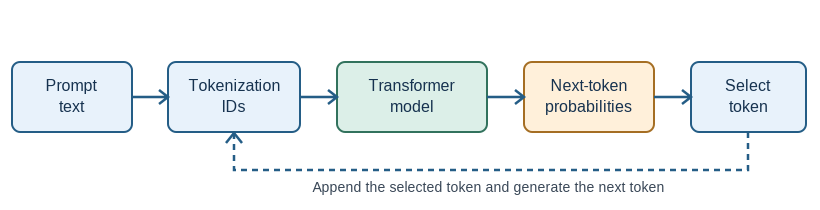
At a high level, a decoder-style autoregressive LLM processes text through the following steps:
- Receive a prompt. The input may include user text, system instructions, prior conversation, and retrieved material.
- Tokenize the input. A tokenizer maps text to token IDs.
- Compute token representations. Embeddings and positional information become the inputs to Transformer layers.
- Process the context. Attention and feed-forward computations build contextual representations.
- Predict scores for the next token. A final output projection produces a score, often called a logit, for each possible next token.
- Select a token. A decoding strategy chooses a next token from the model’s output distribution.
- Repeat. The selected token joins the context, and the model generates subsequent tokens until it stops.
A model typically works with a context window: a limited span of tokens available during a request. The exact window size varies by model and configuration. A long conversation or document can exceed this limit, and fitting within it does not guarantee that every earlier detail is used reliably.
Next-token prediction is more than autocomplete
A toy autocomplete system might count which word commonly follows another word. A modern LLM instead evaluates a sequence through multiple nonlinear layers and learned contextual representations. Its next-token predictions can incorporate long-range context, syntax, domain-specific patterns, and representations useful for tasks such as code generation or answering questions.
Even so, the model’s prediction objective is not the same as a guarantee of truth. A plausible continuation can still be incorrect.
4. A small numerical example of token selection
Imagine a model has processed the prompt:
A square has four
For illustration, suppose it assigns these probabilities to three candidate next tokens:
| Candidate token | Probability |
|---|---|
sides | 0.80 |
corners | 0.15 |
colors | 0.05 |
The probabilities sum to 1 in this deliberately simplified vocabulary. Greedy decoding chooses sides, the highest-probability option. Sampling may choose a different option, depending on the configured distribution.
Real LLMs use much larger vocabularies and can produce unexpected continuations. The table is an illustration, not an output measured from a particular model.
A brief Python example shows the selection principle:
import numpy as np

tokens = [" sides", " corners", " colors"]
probabilities = np.array([0.80, 0.15, 0.05])

# Deterministic choice: choose the most probable token.
greedy_token = tokens[int(np.argmax(probabilities))]
print("Greedy:", greedy_token)

# Sample one token according to the probability distribution.
rng = np.random.default_rng(42)
sampled_token = rng.choice(tokens, p=probabilities)
print("Sampled:", sampled_token)
This example demonstrates decoding only. It does not train or implement a language model. Actual model inference involves token representations, neural-network computations, and a distribution over the full vocabulary.
5. How LLMs acquire their capabilities
An LLM’s lifecycle usually involves several distinct phases.
5.1 Pretraining
Pretraining adjusts model parameters using large datasets. For an autoregressive language model, a common objective is to predict the next token from the preceding tokens.
Given a target sequence, the training process compares the probability assigned to each correct next token with the target and minimizes a loss such as negative log-likelihood:
where represents the model’s learnable parameters and denotes preceding tokens.
Pretraining can teach patterns of language, factual associations, code syntax, document structures, and other useful regularities. It does not directly verify the truth of every learned association.
5.2 Post-training and instruction following
After pretraining, developers may apply supervised fine-tuning and preference-based optimization to improve a model’s ability to follow instructions, respond helpfully, and avoid certain harmful behaviors. The chosen techniques and training data differ across model families.
Pretraining is not the same as instruction tuning: the first develops broad modeling abilities, while the second adapts behavior to desired tasks and response patterns. For more detail, see LLM Pretraining, Fine-Tuning, and Alignment.
5.3 Inference
Inference is the use of trained model parameters to process new inputs and produce outputs. A request does not ordinarily change those parameters. Giving a model additional text during a conversation changes its context, not its learned weights.
This distinction matters when comparing prompting, retrieval, and fine-tuning: they influence behavior in different ways.
6. Why Transformers are important
Transformers became central to modern LLMs because their attention-based layers can construct context-sensitive token representations and support efficient large-scale training.
Three commonly encountered architectural arrangements are:
| Architecture | Typical characteristic | Common use |
|---|---|---|
| Encoder-only | Builds contextual representations from input tokens | Classification, retrieval, representation learning |
| Decoder-only | Often generates tokens autoregressively using causal attention | General-purpose text generation |
| Encoder-decoder | Encodes an input and generates a conditioned output | Translation, summarization, sequence transformation |
Not every model uses the same architecture, and not all language models are generative chat models. A classification model may process language without producing an extended text response.
To study the mechanism at the layer level, read The Transformer Architecture and Attention, Self-Attention, and Multi-Head Attention.
7. What LLMs can do
LLMs can be useful across several categories of language-oriented work:
| Capability | Example task | Important qualification |
|---|---|---|
| Text generation | Draft a product description | Output needs review for correctness and appropriateness |
| Summarization | Condense a long report | The model can omit or distort important details |
| Question answering | Explain a concept | Unverified answers can contain factual errors |
| Translation | Translate a passage | Nuance, terminology, and low-resource languages may be challenging |
| Code generation | Produce a Python function | Generated code requires testing and security review |
| Information extraction | Extract fields from text | Structured output still needs schema validation |
| Classification | Categorize customer requests | Quality depends on instructions, examples, and distribution of inputs |
| Conversational assistance | Help users complete a workflow | Tools and external state require application-level safeguards |
In-context learning
An LLM can sometimes adapt its responses from instructions and examples placed directly in the prompt. This is called in-context learning. For example, a prompt might show three support tickets and their categories, then ask the model to categorize a fourth.
In-context adaptation does not require parameter updates. It differs from fine-tuning, where model weights are changed through a training process.
Tool use and retrieval
An application may let an LLM request a search, run an approved function, or consult a document index. Such capabilities are provided by the surrounding software system, not automatically by the model’s stored parameters.
For example, retrieval-augmented generation can supply relevant external documents to a model. Retrieval can improve grounding, but retrieved information can also be irrelevant, incomplete, outdated, or malicious.
8. Capabilities are not guarantees
A model that generates fluent explanations may still fail on elementary arithmetic, multi-step reasoning, specific factual claims, or tasks requiring information unavailable in its input.
8.1 Hallucinations and factual errors
Hallucination refers to generated content that is false or unsupported yet presented as though it were valid. An LLM might invent a citation, misstate a historical date, or produce a function that uses a nonexistent API.
A model’s confidence-sounding wording is not a calibrated probability of correctness. Reliable applications therefore need source checks, tests, or other verification appropriate to the task.
8.2 Context and knowledge limitations
Important constraints include:
- Context limits: The model cannot necessarily process an unlimited amount of input.
- Incomplete or outdated information: Training data may not cover recent events, specialized documents, or private information.
- Ambiguity: Vague inputs can yield responses that do not match the user’s intent.
- Distribution shift: Unfamiliar tasks and styles may reduce accuracy.
- Non-determinism: Sampling settings or infrastructure details can change outputs between runs.
- Bias: Training and evaluation data can reflect social, linguistic, or geographic imbalances.
8.3 Reasoning and reliability
Models may solve difficult problems and fail on simpler variants. A correct-looking explanation is not proof that intermediate steps are valid. When correctness matters, use independently testable procedures such as unit tests for code, symbolic tools for calculations, or source validation for factual claims.
8.4 Security and privacy
LLM applications can face prompt injection, accidental disclosure of sensitive data, insecure tool execution, and other risks. Instructions embedded in retrieved documents must not automatically acquire the same authority as trusted application instructions.
Users and developers should also consider what data they send to a service, how it is retained, and which tools the application may execute. See Responsible AI, Ethics, and Governance and AI Security Threats and Defenses for broader context.
9. LLMs compared with search engines and databases
An LLM, a search system, and a database answer different engineering needs:
| System | Primary function | Typical strength | Main limitation |
|---|---|---|---|
| LLM | Generate or transform language from context | Flexible natural-language responses | Can produce unsupported claims |
| Search engine | Retrieve relevant indexed material | Provides discoverable sources | Search results require interpretation |
| Database | Store and query structured records | Reliable access to defined stored values | Does not independently explain arbitrary questions |
| LLM with retrieval | Retrieve evidence and generate an answer | Combines source access with readable responses | Still needs retrieval and response evaluation |
An effective application often combines all three rather than treating an LLM as a replacement for a database.
10. Key engineering considerations
When choosing an LLM for a software product, evaluate the complete system rather than a model’s advertised size alone.
| Consideration | Question to ask |
|---|---|
| Task quality | Does the model perform well on representative examples of our actual task? |
| Language coverage | Does it handle the target languages, terminology, and writing systems? |
| Context handling | Can it process the required documents without losing essential details? |
| Latency | How quickly are outputs delivered under expected load? |
| Cost | What is the cost of input, output, and supporting infrastructure? |
| Deployment | Is hosted access acceptable, or is local deployment needed? |
| Security | What data can the model see, and which actions can it trigger? |
| Evaluation | How will failures, regressions, and unsupported claims be detected? |
Model size is not a substitute for evaluation. Smaller models can be effective for well-defined tasks, while larger models may be justified for more demanding work. The right choice depends on measured performance, reliability, deployment constraints, and cost.
11. Worked application example: document question answering
Suppose a university wants a system that answers questions about its academic regulations.
A plain LLM may have general knowledge about universities but lack the institution’s actual current rules. A more reliable application can:
- Store approved policy documents in a searchable collection.
- Retrieve sections relevant to a student’s question.
- Provide those sections and the question to an LLM.
- Ask the model to answer using only supported information and cite relevant sections.
- Check that citations point to retrieved text, and escalate ambiguous or high-impact questions to a human reviewer.
This design separates knowledge retrieval from language generation. It is not infallible: incorrect retrieval, missing policy updates, or misinterpretation can still produce an inaccurate answer.
12. Common misunderstandings
“LLMs store every sentence from their training data.” Training generally compresses patterns into parameters rather than maintaining a conventional searchable record of each source. However, memorization of some training content can occur, so privacy and data-use questions remain important.
“An LLM searches the internet for every answer.” Not inherently. Internet search requires connected tools or services supplied by the application.
“A bigger model is always better.” No. Quality varies by task, training, architecture, inference settings, and evaluation criteria.
“Giving the model an example retrains it.” Prompt examples affect the current context. They do not ordinarily update the model’s weights.
“If the explanation sounds logical, it must be correct.” Fluency and correctness are different properties. Important claims and outputs require external checks.
13. Check your understanding
- How does a language model differ from a chatbot application?
- What does the probability represent?
- Why do LLMs use tokenization and embeddings?
- What is the difference between pretraining, post-training, and inference?
- Why might a model answer a question fluently but incorrectly?
- How does retrieval change an LLM application without retraining the LLM?
- Why should deployment teams measure task quality, latency, and security rather than parameter count alone?
Show short answers
- A language model is a trained computational model; a chatbot adds interaction logic and may add tools, memory, and policies.
- The probability of token given previous tokens in the sequence.
- Tokenization creates manageable units; embeddings convert token identities into numerical representations.
- Pretraining learns broad patterns; post-training adapts behavior; inference uses fixed trained parameters for new inputs.
- Its objective can reward plausible language patterns without verifying facts.
- Retrieval supplies external context that the application places in the prompt.
- Model size alone does not establish usefulness, reliability, affordability, or safe operation.
14. Related PlainCS articles
- Generative AI and Generative Model Families: The broader landscape of generative modeling.
- Text Processing, Tokenization, and Embeddings: How language becomes numerical input.
- The Transformer Architecture: The architecture behind many modern LLMs.
- Attention, Self-Attention, and Multi-Head Attention: How Transformer layers mix contextual information.
- Entropy, Cross-Entropy, and KL Divergence: Information-theoretic training concepts.
- LLM Pretraining, Fine-Tuning, and Alignment: How models are developed and adapted.
- LLM Inference, Decoding, and Sampling: How generation settings control output behavior.
- Retrieval-Augmented Generation: How external knowledge can support generated answers.
15. References and further reading
- NIST AI Glossary: Large Language Model. Terminology for large language models.
- NIST AI Glossary: Foundation Model. Foundation-model terminology and adaptation.
- Google Machine Learning Glossary. Machine-learning and generative-AI terms.
- Attention Is All You Need. The foundational Transformer research paper.
- Stanford HAI: What Is a Large Language Model?. An overview of LLMs and their capabilities.
- OWASP: Large Language Model Glossary. LLM fundamentals and security context.
Related articles in
- AI Agents and Tool-Using Workflows — Learn agent goals, tool invocation, planning, state, permissions, and how to evaluate multi-step AI workflows.
- AI Development Tools: Git, Jupyter, and APIs — Learn how Git, Jupyter notebooks, Python environments, and APIs fit together in reproducible, secure artificial intelligence workflows.
- How AI Is Changing Theoretical Computer Science — AI is beginning to help researchers explore algorithms, mathematical structures, and formal proofs. Here is what it can do, what still needs human judgment, and why verification matters.