People often imagine artificial intelligence doing the kind of work that is easiest to notice: writing a paragraph, answering a question, or producing a picture. But some of the more interesting changes are happening in places most people never see. Researchers are beginning to use AI systems to search through algorithms, explore mathematical structures, and help build formal proofs.
That matters to theoretical computer science because the field is concerned with ideas that are both abstract and surprisingly practical. It asks what can be computed, how efficiently it can be computed, which problems are fundamentally hard, and how we can know that an algorithm is correct. A small improvement in a mathematical bound can change how researchers think about a whole class of problems. A new construction can show that a long-standing approach was not the only possible one.
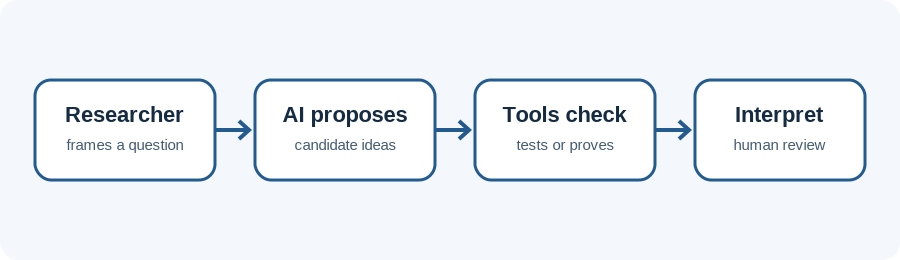
AI is not simply “doing theory” by itself. The strongest examples so far combine a model that can propose candidates with a search process, a program that checks them, or a formal proof assistant that verifies each logical step. This combination gives researchers a new way to explore large spaces of possibilities. It also makes the limits easier to see: a generated idea can be wrong, a verified result can be narrow, and an improvement on a benchmark does not automatically change what we know about computation.
What theoretical computer scientists actually study
Theoretical computer science is the study of computation at a deeper level than any one programming language or product. It includes algorithms, complexity theory, cryptography, logic, data structures, graph theory, information theory, and many other areas.
An algorithm is a precise method for solving a problem. A sorting algorithm, for example, takes a list and puts its items in order. Theoretical computer scientists ask how much time and memory different methods need as the input grows. They also prove claims about the methods: that an algorithm always returns a correct answer, or that no algorithm in a particular model can solve a problem faster than a certain limit.
Complexity theory studies how difficult problems are. Some problems have known efficient solutions. For others, the best known methods become impractical as the input gets larger. Some questions ask whether an efficient solution exists at all. The famous P versus NP question is one example: loosely, it asks whether every problem whose solution can be checked quickly can also be solved quickly. No AI system has resolved that question.
Theoretical work is not only a matter of manipulating symbols. Researchers choose which problems are worth asking, look for patterns, invent definitions, build examples, find counterexamples, and decide whether a result is meaningful. Much of the work can involve long stretches of exploration before a proof or algorithm takes shape.
That exploratory work is where AI tools may be useful. A system can generate candidate solutions or search patterns quickly, especially when there is a way to test candidates automatically. The researcher still needs to decide what to search for and what a successful result would mean.
From suggesting answers to searching for algorithms
A language model on its own produces likely sequences of text or code. This can make it a helpful brainstorming partner, but plausible-looking code is not evidence that a new algorithm works. A more structured approach gives the AI a task, lets it produce candidate programs, and runs those candidates through an evaluator.
One example is FunSearch, a research system pairing a language model with an automated evaluator and an evolutionary search process. The model proposes changes to a program; the evaluator scores the result; promising candidates are used to guide later proposals. In published work, the researchers used this approach on the cap set problem in combinatorics and on heuristics for online bin packing. The work reported improved mathematical constructions and algorithms for those specific tasks. The important point is not that a chatbot solved mathematics by writing an answer. It is that the system searched over programs and used a testable score to distinguish more useful candidates from less useful ones. The FunSearch research paper
A cap set is a collection of points in a mathematical space with a particular restriction: no three points can lie in a straight line. The problem is to understand how large such a set can be as the space grows. A program can generate candidate sets, and code can check whether each candidate follows the rule. That makes it possible to explore many candidates and reliably reject invalid ones. A computer search does not, by itself, prove every general claim about all possible dimensions; a specific construction and a broad theoretical proof are different kinds of results.
Online bin packing is another useful example. Imagine items arriving one by one, with each item needing to fit in a bin of limited capacity. The algorithm has to decide where each item goes before seeing what arrives next. A heuristic is a practical rule of thumb for making these choices. Researchers can test a proposed heuristic against many input sequences and compare its performance with existing rules. If the goal is to minimize the number of bins on a set of test cases, an evaluator can calculate that score exactly.
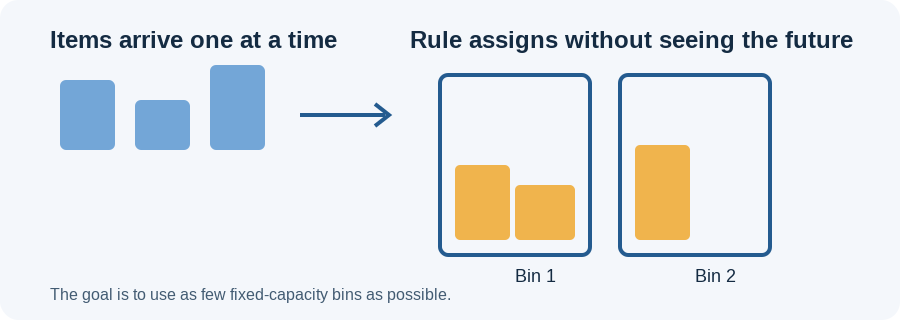
This kind of work sits between theoretical computer science and empirical algorithm engineering. A candidate may perform better on the tested cases while still lacking a proof that it is optimal, or that it performs better on every possible input. The test setup matters: the input distribution, baseline methods, and scoring rules all shape what “better” means.
Systems such as AlphaEvolve follow a related pattern: a language model proposes program changes, and automated evaluation gives feedback in an iterative search. Google researchers have described applying the system to algorithmic and mathematical problems, including work on matrix multiplication. Such reports are promising demonstrations of a research method, but each result should be understood within its stated problem, evaluation, and verification conditions. AlphaEvolve research paper Google Research overview
Matrix multiplication makes a good example because the problem has a simple definition but a surprisingly rich theory. For two square matrices, the familiar method performs a number of scalar multiplications that grows roughly as the cube of the side length. Researchers have spent decades finding ways to reduce that growth rate. AlphaTensor framed the search for matrix multiplication algorithms as a game-like sequence of steps and used reinforcement learning to find algorithms that are provably correct for particular matrix sizes and arithmetic settings. The AlphaTensor paper
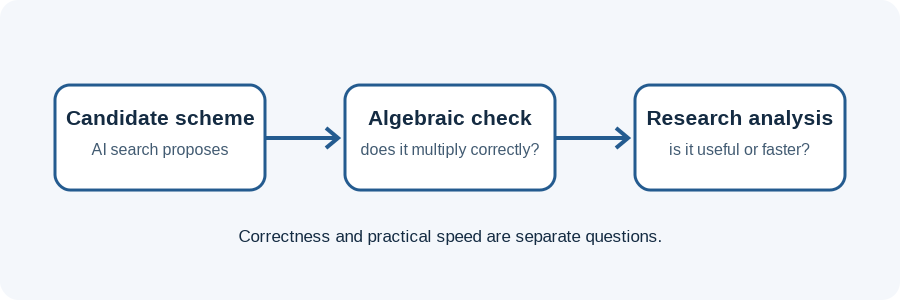
“Provably correct” here is important, but it should be read carefully. If a candidate algorithm can be represented in a finite algebraic form, a computer can check whether its operations produce the desired matrix product. That verifies correctness for the represented computation under the stated assumptions. It does not automatically show that the algorithm is faster on every computer, easier to implement, or asymptotically better for very large matrices. Theoretical efficiency, actual running time, memory use, numerical stability, and hardware behavior are related but distinct questions.
Proof assistants change the reliability story
There is a major difference between a system that writes a convincing proof explanation and one whose proof has been checked by a formal system.
A proof assistant such as Lean lets a user express mathematical definitions and arguments in a formal language. Its kernel checks whether each proof step follows from the rules and previously established results. If the proof is accepted, that gives strong assurance that the formalized statement follows from the formalized assumptions. The checker does not decide whether the theorem is interesting, whether the definitions capture the researcher’s original intent, or whether a paper’s informal explanation matches the formal statement.
AI tools can help write this formal code. They may suggest a lemma, find an existing theorem in a library, fill in a proof step, or translate an informal statement into a formal one. The proof assistant then checks the result. In this arrangement, the language model is the proposer and the formal checker is the strict referee. The checker does not get persuaded by confident wording: a proof that does not follow from the rules is rejected.
Research on systems such as Lean Copilot explores using language models to suggest tactics and proof steps inside Lean. Other approaches train models to work with proof states or to alternate informal reasoning with formal proof construction. These systems are active research, and their results depend on the theorem libraries, benchmarks, and formalization setup used. Lean Copilot paper Lean-STaR paper
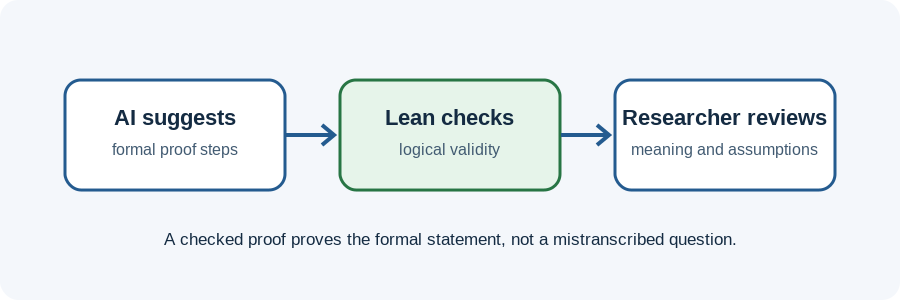
Formal verification is powerful, but it does not remove the need for care. A formal proof only proves the statement that was entered. If the theorem was mistranscribed, if an assumption was accidentally too strong, or if the formal statement is not the claim made in the paper, the checker cannot repair that mismatch on its own. The bridge between a human mathematical question and its formal version is itself a research task.
There is also a practical bottleneck: many research ideas are not already written in the language of a proof assistant. Formalizing definitions, importing or building the needed library results, and finding an appropriate proof structure can take substantial work. AI may reduce some of that effort, but dependable formalization remains a technical challenge.
Why this matters for theoretical computer science
The first impact may be a change in how researchers explore, rather than a sudden replacement of human reasoning. A person can formulate a narrow problem, build an evaluator, and ask a search system to examine variations that would be tedious to try manually. That can help uncover edge cases, surprising constructions, or useful heuristics.
For algorithms, the loop can be especially productive when candidates are executable and the quality of a candidate can be measured. A solver can generate algorithms; tests can check their outputs; benchmarks can compare their speed on representative workloads; and a proof can establish a general correctness property. Those are separate checks, each answering a different question.
In complexity theory, AI could help with the more exploratory parts: searching for small examples, testing conjectures on finite cases, finding counterexamples to overly broad claims, or suggesting reductions between problems. A reduction is a formal way to show that solving one problem would also solve another. However, checking a handful or even a huge number of finite cases cannot prove an unrestricted mathematical statement. A conjecture supported by millions of examples is still a conjecture until there is a proof, or a counterexample.
Search can also change what researchers notice. Humans have limited time and tend to follow familiar paths. A search process may produce an odd-looking candidate that a person would not have tried. The candidate can then become a clue: perhaps it reflects a hidden symmetry, an unexpected invariant, or a more general principle. The durable scientific contribution often includes the explanation of why the construction works and what it teaches us, not only the construction itself.
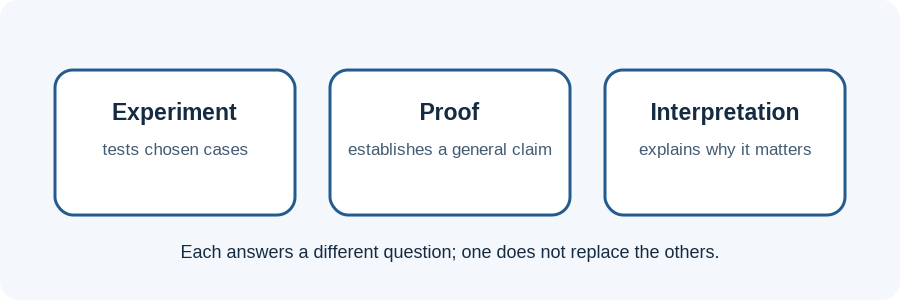
The relationship between empirical and theoretical work may become more intertwined. A discovered algorithm can begin as an experimental improvement. Researchers may then analyze it, prove bounds, find conditions where it excels, or explain why it works. Conversely, a theoretical insight can suggest a program space or scoring rule that makes automated search more effective.
This also raises a question about mathematical understanding. If an AI system finds a correct construction but no one yet understands why it works, the result can still be useful. But understanding matters when researchers want to generalize the result, adapt it to a different setting, or know whether it answers the deeper question. A compact program or formal proof may be easier to inspect than a long string of generated text, but even a verified proof can be difficult for people to interpret.
There are reasonable limits to what we can conclude today. Published successes show that AI-guided methods can contribute to specific algorithmic and mathematical tasks. They do not establish that AI can reliably solve arbitrary open problems, select the most important problems, or replace the judgment needed to interpret a result. Systems often rely on a human-designed representation, evaluator, benchmark, and stopping condition. If the evaluator rewards the wrong thing, search can optimize the wrong thing very effectively.
The less visible impact: better experiments and sharper questions
Even when an AI search does not find a breakthrough, it can still help make research more systematic. A researcher may use a model to translate a rough idea into a small program, generate test instances, or explore variations of a definition. Running a candidate against many edge cases can expose a flaw before someone invests weeks in a proof. A counterexample is often more valuable than another confirming example because it tells us exactly where an idea stops working.
There is a catch: experiments are only as useful as their design. A benchmark can accidentally reward a quirk in the test data rather than a generally good algorithm. If a system is evaluated on a narrow set of inputs, it may overfit to those cases. Researchers need to ask whether the test cases represent the problem, compare against strong baselines, and publish enough detail for others to reproduce the result. In theory, a convincing finite experiment can motivate a conjecture, but it cannot replace a proof about all possible inputs.
AI may also make formalization more attractive. Historically, writing a proof in a proof assistant could feel like translating a clear human argument into a picky programming language. If models become better at helping with that translation, more researchers may formalize results that were previously left as prose. A larger library of checked definitions and theorems could, in turn, give future tools more reliable material to search. This is a feedback loop between software, mathematical libraries, and human research communities, not just between a model and a prompt.
This change could affect training as well. Students may increasingly learn not only how to prove a theorem by hand, but also how to build a small experiment, ask a solver for candidate lemmas, and verify a formal proof. Those are complementary skills. It remains important to understand the underlying mathematics: otherwise a student may be unable to notice that a tool answered a subtly different question or relied on an assumption hidden in the formalization. AI can lower the friction of exploring a subject, but it cannot make conceptual understanding optional.
There is also a community question: which problems will receive more attention when computational search becomes cheaper? Tasks with a crisp evaluator may be easier to automate than questions whose value depends on broad conceptual context. This could skew research toward what is measurable. Researchers and institutions will need to keep valuing explanations, negative results, careful verification, and foundational questions that do not reduce to a score.
A well-documented result will therefore matter even more. Researchers should be able to inspect the question the system was given, the search space it explored, the evaluation procedure, the proof or correctness check, and the assumptions behind each claim. Without that information, it is difficult to tell a genuine mathematical contribution from a promising demo. Reproducibility is not paperwork added after discovery; it is part of how the community decides what has actually been discovered.
What researchers still bring
Theoretical computer scientists contribute more than proof checking. They decide what questions matter, choose definitions that capture the intended concept, and recognize when a result is new or surprising. They can notice that an experiment is answering a narrower question than the paper’s title suggests. They connect an isolated construction to prior literature and explain what follows from it.
AI may expand the range of ideas that can be tested and the amount of search that can be performed. That does not make the human role disappear. It may make some parts of research more like a collaboration between people, models, search algorithms, and formal checkers.
A useful way to think about the current shift is to separate three activities:
- Generate: propose a candidate algorithm, proof step, example, or conjecture.
- Check: run tests, verify algebra, benchmark performance, or use a proof assistant.
- Interpret: decide what the result means, what assumptions it uses, and whether it advances understanding.
AI can contribute strongly to generation and increasingly to parts of checking when the check can be automated. Interpretation remains a human responsibility, and checking only works as well as the formalization or evaluator that defines what is being checked.
So the near-term story is not “AI has solved theoretical computer science.” It is that researchers have new instruments for exploration. Like a microscope or a computer algebra system, these instruments can reveal things that are hard to see unaided. They can also mislead if their results are treated as self-explanatory. The most credible discoveries are the ones whose claims, assumptions, and verification can be examined by others.
AI’s impact on theoretical computer science will ultimately be measured not by how impressive a model’s answer sounds, but by whether it helps produce ideas that survive scrutiny: constructions that can be checked, algorithms whose behavior is understood, proofs that establish the stated claim, and explanations that let other researchers build on the result.
Further reading
- FunSearch: Mathematical discoveries from program search with large language models
- AlphaTensor: Discovering faster matrix multiplication algorithms with reinforcement learning
- AlphaEvolve: A coding agent for scientific and algorithmic discovery
- Lean Copilot: Large language models as copilots for theorem proving in Lean
- Lean-STaR: Learning to interleave thinking and proving
Related articles in AI and Data
- AI Agents and Tool-Using Workflows — Learn agent goals, tool invocation, planning, state, permissions, and how to evaluate multi-step AI workflows.
- AI Development Tools: Git, Jupyter, and APIs — Learn how Git, Jupyter notebooks, Python environments, and APIs fit together in reproducible, secure artificial intelligence workflows.
- AI Knowledge Map: A Body of Knowledge for Artificial Intelligence — A connected guide to the essential concepts, foundations, applications, and engineering practices of artificial intelligence.