Artificial intelligence is not a single technique. Two important approaches are symbolic AI, which works with explicitly represented knowledge and reasoning procedures, and learning-based AI, which develops useful behavior from data or experience. Their differences explain why some systems follow inspectable rules while others recognize patterns that would be difficult to describe rule by rule.
These approaches address overlapping problems and can be combined. Understanding both is necessary before studying machine learning, knowledge representation, and modern AI applications.
Start with a question: Should a student enroll in this course?
Suppose a university registration system must decide whether a student may enroll in Data Structures. The university has a clear requirement: the student must have passed Programming Fundamentals.
One solution is to represent the requirement explicitly: if the prerequisite is completed, enrollment is permitted. The system checks known facts about the student and applies the rule. That is the flavor of symbolic reasoning: meaningful facts and relationships are represented so software can work through them.
Now imagine a second task: predicting which enrolled students may need extra academic support. There may be no reliable single rule. A model could instead learn statistical relationships from past attendance, assessment, and course-performance data. That is a learning-based approach, though its use would require careful privacy, fairness, and validation checks.
The crucial distinction is not whether either program contains an if statement. Almost every program does. It is where the task-specific knowledge comes from and how the system uses it:
| Question | Symbolic approach | Learning-based approach |
|---|---|---|
| Where does task knowledge come from? | Explicit facts, relationships, and rules supplied or curated for the system. | Patterns estimated from training data or experience. |
| How does it reach an answer? | Applies logical inference, search, or planning over representations. | Computes a prediction or decision using learned parameters or structures. |
| What is a typical difficulty? | Maintaining rules when the world is messy or exceptions multiply. | Needing representative data and checking generalization. |
These approaches can coexist. A university might use hard prerequisite rules for eligibility and a learned prediction to offer optional support. The prediction should not silently override an official requirement. That combination prepares us for the idea of hybrid AI, discussed later in this article.
What is symbolic AI?
Symbolic artificial intelligence is an approach to AI that represents information using explicit symbols and structures, then operates on those representations through reasoning, search, or planning procedures.
A symbol stands for something meaningful in a particular system: an object, property, relation, action, or proposition. For example, Student(Amina) can represent that Amina is a student, while Completed(Amina, Programming1) represents a relationship between a student and a course.
The symbols themselves do not make a system intelligent. The important part is that the system can use the represented knowledge to derive conclusions, answer questions, or select actions.
Symbolic AI is also associated with the terms classical AI and, in some contexts, good old-fashioned AI (GOFAI). These are historical labels, not separate modern branches with rigid boundaries.
Components of a symbolic system
| Component | Meaning | Example |
|---|---|---|
| Symbols | Identifiers for objects, properties, or relations. | Amina, Programming1, Completed |
| Facts | Statements represented as known information. | Completed(Amina, Programming1) |
| Rules | Conditions and conclusions expressed explicitly. | If a prerequisite is completed, a course may be taken. |
| Knowledge base | An organized collection of facts and rules. | University course prerequisites. |
| Inference mechanism | A procedure for deriving consequences from knowledge. | Conclude that Amina satisfies a prerequisite. |
| Search or planner | A method for exploring possible states or actions. | Find a valid sequence of courses leading to graduation. |
Not every symbolic system contains all these components. A rule-based expert system may emphasize a knowledge base and an inference engine, while a planning system may emphasize states, actions, goals, and search.
How symbolic reasoning works
Consider an academic advising system with the following information:
- Fact: Amina completed Programming I.
- Rule: A student who completed Programming I has satisfied the prerequisite for Programming II.
- Query: Has Amina satisfied the prerequisite for Programming II?
The reasoning procedure applies the rule to the fact and derives the answer yes. The conclusion follows from the represented information; no statistical training was required.
Using simplified logical notation:
Therefore:
Here represents a student, is Programming I, and is Programming II. The example assumes completion of Programming I is the only prerequisite for Programming II. If an institution has other requirements, they must also be represented and checked.
Important: A conclusion is justified only relative to the system’s rules, facts, and assumptions. Correct logical reasoning cannot repair incorrect, missing, or outdated knowledge.
Inference, search, and planning
These operations are related but different:
- Logical inference derives consequences from statements. It answers questions such as, “What follows from these facts and rules?”
- Search explores possible states or solutions. It answers questions such as, “Which route reaches the destination?”
- Planning selects a sequence of actions expected to achieve a goal. It answers questions such as, “Which courses should be completed, and in what order?”
Two common rule-processing strategies are forward chaining, which begins with available facts and derives new facts, and backward chaining, which begins with a goal and searches for information that would establish it. Both can be implemented with explicit rules, but they serve different directions of reasoning.
Major symbolic AI techniques
| Technique | Central idea | Representative use |
|---|---|---|
| Rule-based expert systems | Apply explicitly encoded domain knowledge. | Troubleshooting equipment using diagnostic rules. |
| Propositional and first-order logic | Represent statements and relationships with formal semantics. | Checking whether a conclusion follows from premises. |
| Knowledge graphs and ontologies | Describe entities, relations, and categories. | Organizing concepts and relationships in a domain. |
| Constraint satisfaction | Find assignments satisfying a set of restrictions. | Timetabling and resource allocation. |
| Search algorithms | Explore states according to a search strategy. | Route finding or puzzle solving. |
| Automated planning | Choose actions to reach specified goals. | Task sequencing for a robot or workflow. |
Symbolic AI is broader than systems containing if statements. A normal application may check if password_is_valid without doing knowledge representation, inference, or search. What makes an approach symbolic AI is the explicit representation and systematic manipulation of meaningful knowledge or states to solve an intelligent task, not merely the presence of conditional code.
What is learning-based AI?
Learning-based artificial intelligence is an approach in which a computational system improves or develops task-related behavior by learning from examples, observations, interactions, or feedback, rather than relying exclusively on individually specified rules for every case.
Machine learning (ML) is the central family of methods for this approach. A learning algorithm uses available data and a learning objective to construct or adjust a model. Once learned, the model can make predictions or produce other outputs for new inputs.
For example, a spam detector might learn associations between message features and labels such as spam or not spam. Instead of writing a condition for every suspicious phrase, a developer provides labeled examples and chooses a learning method.
How a learning-based system works
A typical supervised-learning workflow is:
- Define the task. For example, classify incoming messages.
- Collect examples. Gather messages with appropriate labels.
- Represent the data. Convert text into numerical features.
- Choose a model and learning procedure. For example, a probabilistic text classifier.
- Train the model. Estimate parameters from the training examples.
- Evaluate generalization. Test the fitted model on separate, representative examples.
- Use the model for inference. Apply it to new messages.
- Monitor performance. Check whether the input patterns or error rates change.
The distinction between training and inference is explained in detail in AI Systems, Models, Training, and Inference.
A simplified predictive model can be written as:
Here is an input, is a model with learned parameters , and is the predicted output. Not every learning method is a conventional supervised predictor, but this expression captures the basic idea of many widely used models.
Learning does not always require labels
Different learning paradigms use different feedback or structure:
| Learning paradigm | Source of learning signal | Example |
|---|---|---|
| Supervised learning | Labeled input-output examples. | Spam classification. |
| Unsupervised learning | Structure present in unlabeled data. | Grouping similar customers. |
| Self-supervised learning | Targets constructed from the data itself. | Predicting missing or subsequent text tokens. |
| Reinforcement learning | Rewards and feedback from interaction. | Learning a policy for a game or robot. |
Deep learning is a subset of machine learning based on multilayer neural networks, not a synonym for all learning-based AI. Decision trees, linear regression, and many probabilistic models are also learning-based methods.
How the two approaches differ
The major difference is where the task-solving knowledge comes from and how the system uses it.
| Dimension | Symbolic AI | Learning-based AI |
|---|---|---|
| Main representation | Explicit rules, facts, relations, states, or constraints. | Learned parameters, features, representations, or policies. |
| Primary source of behavior | Encoded knowledge and reasoning procedures. | Patterns or policies learned from data or experience. |
| Typical development work | Specify knowledge and inference/search methods. | Choose model, data, objective, and training method. |
| New information | Modify facts, rules, or represented states. | Supply new inputs; retrain or adapt if model parameters must change. |
| Explanation | A rule trace or proof may be available. | Interpretation depends on model and explanation technique. |
| Strength | Explicit constraints, formal structure, and inspectable reasoning. | Recognizing complex patterns and handling variable inputs. |
| Common limitation | Knowledge acquisition, coverage, and combinatorial complexity. | Data requirements, generalization failures, and hard-to-interpret behavior. |
| Example | A rule-based eligibility checker. | A classifier trained on historical applications. |
These are typical tendencies, not absolute properties. Symbolic reasoning can use uncertainty; learned models can be interpretable; and some learning algorithms generate explicit rules or decision trees. A rule-based system is not automatically correct or fair, just as a learned model is not automatically flexible or accurate.
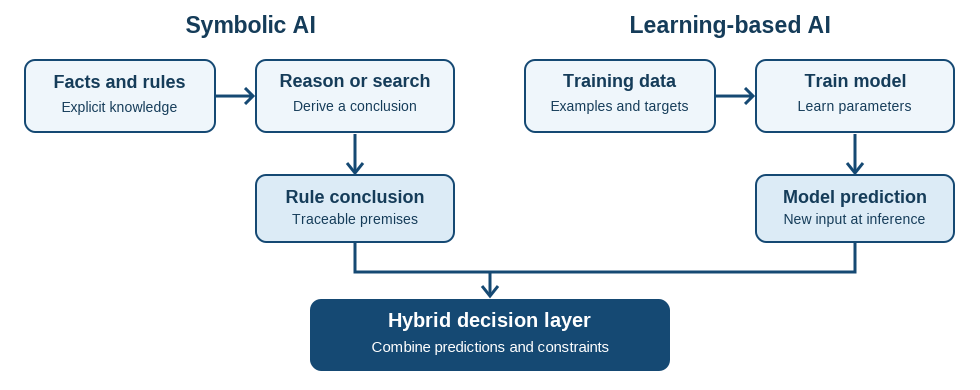
Worked example: Classifying incoming messages
Suppose a service receives emails and must decide whether each message is spam. We can approach the task with rules, with a learned classifier, or with both.
Approach 1: Explicit rules
A developer can define a rule that flags messages containing selected phrases:
def classify_with_rules(message: str) -> str:
    text = message.lower()
    blocked_phrases = ("claim your prize", "guaranteed cash")

    if any(phrase in text for phrase in blocked_phrases):
        return "spam"

    return "not spam"


print(classify_with_rules("Claim your prize today"))  # spam
print(classify_with_rules("You have won a reward"))    # not spam
This example uses manually specified conditions. It is useful for demonstrating explicit rule-based behavior, but it is only a basic keyword filter, not a complete symbolic reasoning system. A richer symbolic system might represent sender relationships, trusted organizations, exception rules, and evidence supporting each classification.
The rule is easy to inspect. However, the second message illustrates a coverage problem: an unfamiliar suspicious phrase will not match a rule until someone updates the knowledge or rule set. The first rule can also produce false positives when a legitimate message quotes the suspicious phrase.
Approach 2: Learn from examples
Instead of choosing every phrase manually, we can train a small statistical text classifier. The following example uses scikit-learn and assumes it has been installed with pip install scikit-learn.
from sklearn.feature_extraction.text import CountVectorizer
from sklearn.naive_bayes import MultinomialNB
from sklearn.pipeline import make_pipeline

messages = [
    "claim your cash prize now",
    "win a reward instantly",
    "free money offer today",
    "exclusive prize for you",
    "meeting agenda for monday",
    "please review the report",
    "your project submission is due",
    "lecture notes are attached",
]

labels = [
    "spam", "spam", "spam", "spam",
    "not spam", "not spam", "not spam", "not spam",
]

model = make_pipeline(CountVectorizer(), MultinomialNB())
model.fit(messages, labels)  # Training

new_message = "win your free prize"
print(model.predict([new_message])[0])  # Inference
The vectorizer converts text into word-count features. The MultinomialNB classifier then estimates statistical patterns from the labeled examples. Unlike the first example, the programmer does not explicitly instruct the classifier to check each particular phrase.
This tiny dataset exists only to demonstrate the mechanism. Its predictions are not reliable performance evidence: realistic systems need substantially more representative data, careful evaluation on held-out examples, and checks for changing message patterns.
Approach 3: Combine rules and a model
A hybrid design could perform these operations:
- Apply explicit policy rules, such as blocking a known malicious sender or requiring manual review for messages with dangerous attachments.
- Use a learned classifier to estimate whether other messages resemble spam.
- Apply thresholds and decision policies to determine what is blocked, delivered, or sent for review.
- Log decisions and evaluate both the rule logic and the learned classifier.
This arrangement does not guarantee better performance merely because it uses two methods. Poor rules can override good predictions, and an unreliable model can still make mistakes. The combination should be tested against defined system requirements.
Hybrid and neuro-symbolic AI
Hybrid AI is a broad description for systems that combine different AI techniques. Neuro-symbolic AI more specifically combines neural-network learning with symbolic knowledge or reasoning.
An ordinary rule-based workflow wrapped around a machine-learning classifier is a practical hybrid system, but it is not necessarily a tightly integrated neuro-symbolic model. Neuro-symbolic methods may connect learned representations with logical constraints, structured concepts, or reasoning mechanisms inside a coordinated learning-and-inference process.
Possible combinations include:
- A perception model identifies objects in an image, while a symbolic planner decides which actions a robot may take.
- A language model extracts candidate facts, while a knowledge base checks relationships and constraints.
- A neural model proposes solutions to a structured problem, while a constraint solver rejects invalid candidates.
- A learning system uses domain knowledge to guide training, narrow the search space, or validate outputs.
This area is useful because real applications often contain both uncertain information and firm constraints. A model may estimate what is likely; a reasoning or policy layer may establish what is permitted, possible, or logically consistent under explicit assumptions.
Choosing an approach for a real problem
Begin with the task, available information, constraints, and consequences of error. Do not choose a technique merely because it is popular.
| Situation | Likely starting point | Reason |
|---|---|---|
| The rules are complete, stable, and easy to express. | Conventional logic or symbolic rules. | Explicit requirements can be checked directly. |
| The task requires formal constraints or multi-step planning. | Constraint solving, symbolic search, or planning. | The problem has a structured state and goal. |
| Large amounts of representative labeled examples exist. | Supervised machine learning. | Statistical patterns can be learned and evaluated. |
| Inputs are images, audio, or unstructured natural language. | Often machine learning or deep learning. | Relevant patterns may be difficult to encode manually. |
| Learned perception must obey strict policies. | Hybrid architecture. | Different components can handle perception and constraints. |
| A database query or simple formula fully solves the task. | Conventional software. | AI adds unnecessary complexity. |
A high-stakes problem needs additional consideration. For example, an automated decision affecting employment, safety, or access to services should be evaluated for accuracy, bias, accountability, and whether human review is required. Neither rules nor statistical models eliminate these responsibilities.
Strengths and limitations
Symbolic AI
Strengths: Explicit knowledge can be inspected, rules can be tested, and some representations support formal reasoning about constraints and consequences. These properties are valuable where the reasoning structure must be clear.
Limitations: Creating and maintaining a comprehensive knowledge base can be difficult. Everyday language and real-world situations contain ambiguity and exceptions. Search and inference may also become computationally expensive as the number of possible states or relations grows.
Learning-based AI
Strengths: Models can detect statistical regularities in large or complex datasets, including patterns in language, vision, and audio that are impractical to specify with exhaustive rules. Many models generalize to inputs not seen during training.
Limitations: Generalization is not guaranteed. Results depend on training data, modeling assumptions, and evaluation methods. Models may be hard to interpret, can fail after real-world conditions change, and may learn spurious correlations.
Hybrid AI
Strengths: Complementary components can address different requirements, such as prediction, policy constraints, and multi-step decisions.
Limitations: Combining methods adds engineering complexity, integration risks, and more components to test. A hybrid system needs a clear policy for conflicts between learned predictions and explicit rules.
Common misconceptions
“Symbolic AI is obsolete”
Symbolic techniques remain relevant in knowledge representation, formal reasoning, constraint solving, search, and planning. Modern machine learning has expanded what AI can do, but it has not replaced every structured reasoning problem.
“Learning-based AI has no rules”
A learned model follows mathematical computations and is created by a defined learning algorithm. The distinction is not that one system has logic and the other is arbitrary. It is that task-specific behavior is often encoded explicitly in symbolic methods and estimated from data in learning methods.
“A learned model is always a neural network”
Decision trees, logistic regression, naive Bayes, and other non-neural methods are machine learning. Deep learning is only one family within the broader field.
“Symbolic AI never uses statistics”
Some AI methods combine symbolic representations with probabilistic reasoning. The symbolic-versus-learning distinction is a useful introduction, not an exhaustive classification of every AI technique.
“A rule trace proves the answer is correct”
A trace can show why a system reached its conclusion under a particular rule set. It cannot by itself prove that the original facts reflect reality, the rules cover every exception, or the result is appropriate for the real-world context.
Related concepts and next reading
This article completes the initial foundations sequence in the AI Knowledge Map. Read What Is Artificial Intelligence? for the broader field and AI Systems, Models, Training, and Inference for the distinction between AI methods and complete applications.
The learning-based path continues with Machine Learning Paradigms and Model Training, Overfitting, and Generalization. The symbolic path continues with Knowledge Representation and Automated Reasoning and Search, Planning, and Decision-Making.
Availability note: Some linked PlainCS pages are planned in the knowledge map and may not yet be published.
References
- Russell and Norvig, Artificial Intelligence: A Modern Approach, 4th edition. Foundational coverage of search, logic, knowledge representation, planning, and learning.
- Stanford Encyclopedia of Philosophy, Logic-Based Artificial Intelligence. Technical and historical discussion of knowledge-based reasoning and logic in AI.
- Stanford Encyclopedia of Philosophy, Artificial Intelligence. Broader perspective on symbolic, probabilistic, and learning-based methods.
- scikit-learn User Guide, Naive Bayes. Explanation of the multinomial naive Bayes model used in the Python example.
- IBM Research, Neuro-symbolic AI. Research overview of integrating statistical learning with symbolic knowledge and reasoning.
Related articles in
- AI Agents and Tool-Using Workflows — Learn agent goals, tool invocation, planning, state, permissions, and how to evaluate multi-step AI workflows.
- AI Development Tools: Git, Jupyter, and APIs — Learn how Git, Jupyter notebooks, Python environments, and APIs fit together in reproducible, secure artificial intelligence workflows.
- How AI Is Changing Theoretical Computer Science — AI is beginning to help researchers explore algorithms, mathematical structures, and formal proofs. Here is what it can do, what still needs human judgment, and why verification matters.