A robot learning to balance cannot simply memorize one correct action. It must respond to changes in position, speed, and sensor readings. Some actions help; others make balance worse. Reinforcement learning (RL) studies how an agent can improve its choices through interaction and feedback.
Robotics is broader than reinforcement learning. Many successful robots use conventional control, planning, estimation, and carefully engineered software. RL is one possible method for learning decisions or control policies.
Reinforcement learning: the core idea
Reinforcement learning is an approach in which an agent learns a behavior policy through interaction with an environment, using a reward signal to evaluate consequences of actions. The reward is not necessarily immediate, and maximizing the next reward is not always the same as maximizing long-term success.
The key terms are:
| Term | Meaning |
|---|---|
| Agent | The system selecting actions |
| Environment | What responds to those actions |
| State | Relevant description of the current situation |
| Action | A choice the agent can make |
| Reward | Numeric feedback on an outcome |
| Policy | A strategy for selecting actions |
| Episode | A run of interaction ending at a terminal condition or horizon |
| Return | Accumulated future reward, often discounted |
The agent-environment loop
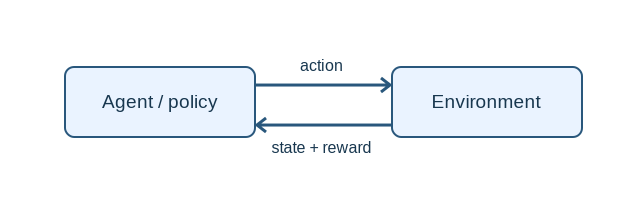
A standard objective uses a discounted return:
Here is a future reward and between 0 and 1 discounts more distant rewards. In finite episodes, the sum ends when the episode does.
Exploration and exploitation
An agent faces a choice: use an action already known to work, or try something uncertain that might work better. This is the exploration-exploitation trade-off.
One introductory method is an -greedy policy. With probability , choose a random action; otherwise choose the best action currently estimated. Random action selection is not always safe for a real robot, so exploration often occurs in simulation or within a constrained safety envelope.
Q-learning in a small environment
Q-learning estimates the value of taking action in state and then following a good future strategy. Its one-step update is:
The symbols mean: learning rate , observed reward , next state , and discount factor . The maximum term is zero when the next state is terminal in the usual episodic formulation.
Here is a small numeric example:
q_old = 2.0
reward = 3.0
best_next_q = 4.0
alpha = 0.1
gamma = 0.9
q_new = q_old + alpha * (reward + gamma * best_next_q - q_old)
print(round(q_new, 3))  # 2.46
This is one update, not a complete training algorithm. Learning useful policies requires repeated interaction, a suitable reward design, and evaluation on varied situations.
Robotics: perception, planning, and control
A robot typically combines multiple subsystems:
- Sensing: cameras, encoders, inertial sensors, lidar, or other devices acquire measurements.
- State estimation: software estimates position, velocity, and other relevant variables from noisy measurements.
- Planning: a route or action sequence is selected.
- Control: commands are computed for motors or actuators.
- Feedback: the system measures the result and adjusts its behavior.
A classical feedback controller, such as a PID controller, can be a good choice for many low-level motion tasks. Reinforcement learning is more attractive when suitable controllers are difficult to hand-design, but training costs and safety constraints must be addressed.
Simulation and the reality gap
Physical robot experiments can be expensive, slow, or dangerous. Many teams train or test policies in a simulator first. However, simulated friction, sensor noise, collisions, and dynamics never perfectly match reality. Sim-to-real transfer aims to move a policy from simulation into physical operation while accounting for these differences.
Domain randomization varies simulation properties during training so the policy experiences a broader range of conditions. This can help robustness but does not guarantee safe deployment.
Common RL methods
- Value-based methods: learn estimates such as Q-values and choose actions based on them.
- Policy-gradient methods: directly optimize parameterized policies.
- Actor-critic methods: combine a policy (actor) with a value estimator (critic).
- Model-based methods: learn or use a model of environmental dynamics for planning.
These methods differ in data efficiency, stability, assumptions, and suitable action spaces. A continuous-action robot often needs methods different from those used for discrete game controls.
Evaluation and safety
Report more than average reward. Examine task completion, collision rate, worst-case failures, robustness across starting conditions, energy use, and performance under sensor faults. For safety-critical systems, physical limits and emergency-stop mechanisms should be enforced independently of a learned policy.
Related PlainCS articles
- Search, Planning, and Decision-Making
- Machine Learning Paradigms
- Neural Network Fundamentals
- AI Limitations, Robustness, and Trustworthiness
Further reading
Related articles in
- AI Agents and Tool-Using Workflows — Learn agent goals, tool invocation, planning, state, permissions, and how to evaluate multi-step AI workflows.
- AI Development Tools: Git, Jupyter, and APIs — Learn how Git, Jupyter notebooks, Python environments, and APIs fit together in reproducible, secure artificial intelligence workflows.
- How AI Is Changing Theoretical Computer Science — AI is beginning to help researchers explore algorithms, mathematical structures, and formal proofs. Here is what it can do, what still needs human judgment, and why verification matters.