Multimodal artificial intelligence refers to AI systems that process, relate, or generate information involving more than one modality, such as text, images, audio, video, or sensor measurements. A modality is a particular form or channel through which information is represented or observed.
A text-only classifier processes one modality. An application that answers questions about a photograph uses both visual information and language. A system that listens to spoken instructions, inspects camera input, and produces spoken responses combines several modalities in one workflow.
Multimodal AI is not a single algorithm or neural network architecture. It describes a family of capabilities and system designs. Different systems combine modalities at different stages and may use one model or several cooperating models.
Start with an example: asking about a photograph
Imagine photographing a damaged bicycle and asking, “Which part looks bent?” A multimodal system needs information from the image and the written question. A text-only model has no access to the photographed details. A multimodal model may encode visual regions, combine them with language features, and generate an answer. The result still needs verification: visual ambiguity, occlusion, and training limitations can produce confident mistakes.
1. What counts as a modality?
Common modalities include:
| Modality | Typical representation | Example task |
|---|---|---|
| Text | Characters, tokens, token embeddings | Answer questions about a document |
| Images | Pixel arrays, patches, visual embeddings | Describe a photograph |
| Audio | Waveforms, spectrograms, acoustic tokens | Transcribe or interpret speech |
| Video | Frames, timestamps, sometimes audio | Describe an event in a clip |
| Structured measurements | Numerical features and time-series samples | Interpret device readings |
| Spatial and motion data | Coordinates, depth maps, trajectories | Understand movement in robotics |
Modalities are not the same as file formats. A JPEG and a PNG are different formats for image data, not separate modalities. Video may contain image frames, sound, and temporal information, so treating it as an unordered collection of pictures can lose important meaning.
2. Why combine multiple modalities?
Different inputs can provide complementary evidence. For example:
- Text in a product description tells a model the item’s stated attributes.
- A product photograph shows its actual appearance.
- Audio can reveal what a speaker said and how sounds unfolded in time.
- Video can show the order of actions and changes across frames.
A multimodal system can relate these signals to solve tasks that are difficult or impossible with one modality alone. However, multiple modalities do not automatically improve accuracy: one channel can be noisy, missing, irrelevant, or misleading.
Example: interpreting a traffic scene
A single image might show a vehicle near a crossing. A short video can indicate whether the vehicle is moving toward or away from it. Audio may capture a warning signal. Combining the sources can improve understanding, provided the system correctly aligns their timing and meaning.
The same principle applies to accessibility tools, document understanding, medical research, robot perception, and interactive assistants. High-stakes applications still require domain-specific validation and appropriate human oversight.
3. The multimodal processing pipeline
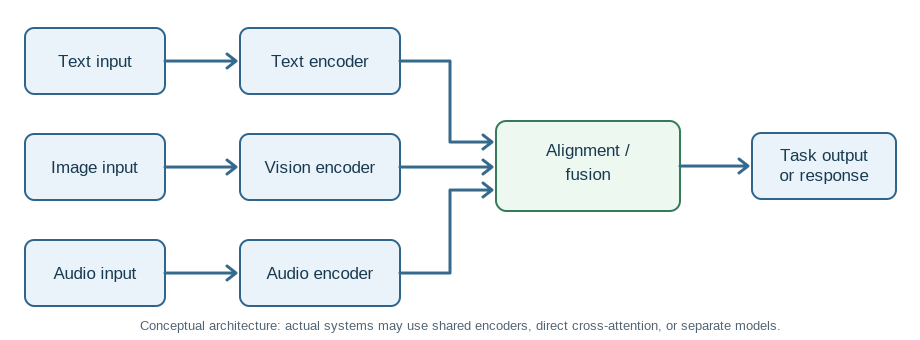
A typical system may follow these stages:
- Acquire input: Receive text, pixels, audio samples, video frames, or sensor measurements.
- Preprocess: Resize images, resample audio, split video into frames, normalize measurements, or tokenize text.
- Encode each modality: Convert the raw inputs into numerical representations.
- Align or fuse representations: Establish relationships among the representations, often with attention or learned projections.
- Perform a task: Classify, retrieve, reason over, generate, or take an action based on the combined information.
- Decode the output: Produce text, a classification, an image, speech, or another requested form.
- Evaluate: Assess task correctness and whether the output is actually supported by the supplied modalities.
4. Representing different inputs numerically
A model cannot directly operate on a sentence, photograph, or sound recording as a human perceives it. Its computations work on numerical structures, usually tensors.
4.1 Text representations
Text is often divided into tokens, mapped to integer identifiers, and transformed into embedding vectors. Contextual layers then modify these representations according to nearby or attended-to tokens.
For background, see Text Processing, Tokenization, and Embeddings.
4.2 Image representations
An image can begin as a tensor with height, width, and channel dimensions. Vision models may use convolutional features or split the image into patches and produce one or more embeddings for those patches.
A visual encoder generally learns representations useful for tasks such as identifying objects, recognizing visual patterns, or associating image content with text. Resolution, cropping, and patch selection can influence which details remain available to the model.
4.3 Audio representations
Digital audio is sampled over time. Models may process waveform samples, spectrogram-like features, or learned acoustic tokens. Speech carries lexical information, timing, background sounds, and speaker-related characteristics.
Audio processing often needs to account for sample rate, sequence length, silence, noise, and timing. See Speech and Audio AI.
4.4 Video representations
Video combines temporal structure with visual content and often sound. Models may encode sampled frames, short frame sequences, or spatiotemporal features. Temporal position matters: a person placing an object on a table differs from a person removing it, even when individual frames appear similar.
Long videos can be costly to process, so systems may sample frames or summarize segments. Sampling too sparsely risks missing brief but important events.
5. Modality alignment: connecting related information
Cross-modal alignment means learning or establishing relationships between representations from different modalities. A model might learn that a caption describing a bicycle corresponds to an image showing a bicycle.
A frequently used approach is contrastive learning. The model is trained to increase similarity between correctly matched image-text pairs while decreasing similarity for mismatched pairs.
Let the image encoder produce vector and the text encoder produce vector . A common similarity measure is cosine similarity:
A high similarity score suggests that the learned representations are related; it is not a calibrated probability that the caption is true.
Contrastive systems can support text-to-image retrieval: embed a text query, compare it with stored image embeddings, and rank images by similarity. This retrieval capability does not, by itself, imply that the model can generate images or reason accurately about every scene.
Worked example: matching a description to an image
Suppose a model produces these hypothetical normalized embedding similarities:
| Text description | Image–text similarity |
|---|---|
| “A red bicycle beside a wall” | 0.84 |
| “A dog running in a park” | 0.13 |
| “A bowl of fruit on a table” | 0.06 |
The first caption ranks highest for that image. These numbers illustrate ranking only. Actual scores depend on the model, data, and preprocessing.
6. Strategies for combining modalities
Multimodal systems differ in when and how they combine information.
| Strategy | Main idea | Advantage | Limitation |
|---|---|---|---|
| Early fusion | Combine low-level or intermediate inputs before much task processing | Can learn detailed cross-modal interactions | Sensitive to input alignment and missing data |
| Late fusion | Combine predictions or scores from separate models | Modular and relatively easy to maintain | May miss fine-grained interactions |
| Intermediate fusion | Combine learned features during processing | Balances independent feature learning with interactions | Architecture and training can be complex |
| Cross-attention | One modality selectively attends to representations of another | Flexible information exchange | Can be computationally expensive |
These approaches can overlap. For example, cross-attention is a mechanism that may be used as part of an intermediate-fusion architecture.
Early fusion
Inputs or features are combined near the beginning. This may suit synchronized sensor streams with compatible time steps, but the model needs a sensible strategy for mismatched shapes and missing channels.
Late fusion
Independent models produce outputs that are then combined. A system could estimate a sound-event class from audio and an object class from video, then combine their predictions. This is useful when separate components already exist, though it cannot always capture detailed relationships between words, sounds, and pixels.
Cross-attention and joint reasoning
Attention mechanisms allow representations from one sequence to incorporate information from another. For example, a language representation may attend to visual tokens while answering a question about an image.
Self-attention relates positions within a sequence; cross-attention typically uses queries from one set of representations and keys and values from another. The exact implementation depends on the architecture. See Attention, Self-Attention, and Multi-Head Attention.
7. Common multimodal model architectures
Three broad patterns are useful to recognize.
7.1 Dual-encoder models
Separate encoders map two modalities into a comparable embedding space. Image–text dual encoders are useful for retrieval, similarity scoring, and some zero-shot classification workflows.
Because they can encode images and captions separately, a system can precompute and index embeddings efficiently. However, they do not necessarily perform detailed, multi-step reasoning about individual images.
7.2 Encoder–language-model systems
A pretrained vision or audio encoder produces features that are adapted into a language model’s expected representation space. A connector, projection layer, or attention component provides the interface.
These architectures can answer questions and generate text conditioned on nontext inputs. They must learn not just language patterns but also how to use evidence from the other modality.
7.3 Unified multimodal models
Some systems operate over multiple kinds of tokens within a more integrated architecture. They may be trained for understanding and generation across modalities, sometimes with different output heads or specialized decoders.
The label unified does not guarantee that every modality receives identical processing or that the system has equal proficiency in all of them.
8. Multimodal understanding versus generation
These are different tasks, and an application may support one without the other.
Multimodal understanding uses inputs from one or more modalities to produce an interpretation, prediction, or answer. Examples include image question answering, document extraction, and audio-video event recognition.
Multimodal generation produces outputs such as images, speech, or video from prompts or other conditions. Examples include text-to-image generation, text-to-speech, and image-conditioned video generation.
A model that generates a caption for a photo is generating text about an image, not generating a new image. A model that produces an image from a sentence performs a different kind of generation.
For generative model families, see Generative AI and Generative Model Families.
9. Training multimodal systems
Training may involve data paired across modalities, such as an image and its caption, a spoken utterance and transcript, or synchronized audio and video.
Important training objectives include:
- Contrastive alignment: Bring matched representations closer together and separate mismatched pairs.
- Matching or classification: Predict whether inputs correspond or assign a task label.
- Conditional generation: Predict text, audio, images, or other output conditioned on supplied inputs.
- Masked or reconstruction objectives: Learn to recover missing or altered content.
- Instruction tuning: Train the system to respond to user requests involving different modalities.
A model may combine several objectives across pretraining and post-training. Pretraining learns broadly useful representations, while fine-tuning adapts the model to particular tasks or output behaviors.
Data alignment and labeling
Correct alignment is essential. A video caption must describe the correct scene; a speech transcript must correspond to the correct recording; and a document-question pair should identify information actually present in the document.
If the training pipeline mismatches inputs, the system can learn weak or false associations. Label errors, poor translations, missing context, duplicate records, and biased sampling can all reduce reliability.
Modality imbalance
One modality may dominate the loss or provide shortcuts that work on training data but fail in deployment. For example, a video model may learn background cues rather than the action of interest. Evaluation must determine whether the model genuinely uses the necessary modalities.
10. Practical Python example: a simple image–text retrieval mechanism
The following example demonstrates ranking with existing embeddings. It is deliberately not a pretrained multimodal encoder: the vectors are small, illustrative values, allowing us to inspect the similarity calculation without downloading model weights.
import numpy as np

# Illustrative embeddings that have already been mapped
# into the same three-dimensional representation space.
image_embedding = np.array([0.9, 0.3, 0.1], dtype=float)

captions = {
    "A bicycle near a wall": np.array([0.85, 0.35, 0.10]),
    "A dog in a park": np.array([0.10, 0.90, 0.20]),
    "A bowl of fruit": np.array([0.10, 0.15, 0.95]),
}


def cosine_similarity(a: np.ndarray, b: np.ndarray) -> float:
    denominator = np.linalg.norm(a) * np.linalg.norm(b)
    if denominator == 0:
        raise ValueError("Cosine similarity requires nonzero vectors")
    return float(np.dot(a, b) / denominator)


ranked = sorted(
    (
        (caption, cosine_similarity(image_embedding, embedding))
        for caption, embedding in captions.items()
    ),
    key=lambda item: item[1],
    reverse=True,
)

for caption, score in ranked:
    print(f"{score:.3f}  {caption}")
Example output (rounded):
0.998  A bicycle near a wall
0.430  A dog in a park
0.249  A bowl of fruit
The operation is meaningful in a real retrieval system only when the image and text embeddings come from compatible, appropriately trained encoders. Arbitrary embeddings do not acquire semantic meaning merely because cosine similarity is computed.
A production system commonly adds embedding normalization, batched inference, an index for efficient search, metadata filtering, and evaluation on real labeled image–text pairs.
11. Applications of multimodal AI
| Application | Modalities | Typical operation |
|---|---|---|
| Visual question answering | Image + text | Answer a question grounded in image content |
| Document understanding | Page images + recognized text + layout | Extract fields or answer document questions |
| Voice assistants | Speech + text, sometimes vision | Interpret spoken requests and respond |
| Video analysis | Video + timestamps, sometimes audio and text | Summarize or locate events |
| Accessibility support | Camera input + language + speech | Describe selected visual information |
| Robotics | Vision + sensors + language | Perceive surroundings and follow bounded instructions |
| Cross-modal search | Text + images or audio | Retrieve relevant content across formats |
The input combinations, deployment constraints, and evaluation methods vary significantly among these applications.
12. Evaluating multimodal models
Evaluation must measure whether a system performs the intended task and whether it uses the supplied modalities correctly.
| Task | Example evaluation method |
|---|---|
| Image–text retrieval | Recall@K or ranking metrics on verified pairs |
| Visual question answering | Correctness against annotated answers, with ambiguity review |
| Image classification | Accuracy, precision, recall, or F1 on a representative dataset |
| Speech recognition | Word error rate, plus performance across speakers and acoustic conditions |
| Document extraction | Field-level precision, recall, and exactness as appropriate |
| Generated descriptions | Human review, factual grounding checks, and task-specific benchmarks |
| Video understanding | Correct event identification and temporal grounding |
Tests that single-modality evaluation can miss
- Cross-modal consistency: Does the text answer agree with the image or audio evidence?
- Temporal alignment: Does a video answer identify the correct moment or sequence?
- Missing-modality robustness: What happens when audio is absent or an image cannot be decoded?
- Conflicting inputs: How does the system handle a misleading caption paired with a photograph?
- Fine-detail robustness: Can it read small text or identify objects when resolution is limited?
- Subgroup and environment variation: Does performance hold across relevant languages, accents, devices, lighting, and recording conditions?
Benchmarks should reflect actual use. A high score on general image questions does not establish reliability for medical interpretation, navigation, or safety-critical decisions.
13. Limitations and engineering challenges
Hallucinations and unsupported details
A model can produce a fluent description of objects or events that are not present. Responses should be checked for grounding in the input, particularly when image quality or context is limited.
Missing or misaligned information
Sensors may record at different times, audio can be delayed, video frames can be skipped, and text may refer to an earlier event. Temporal and semantic alignment need explicit handling.
Compute, memory, and latency
High-resolution images, long audio clips, and long videos can create large input sequences. More tokens or features generally increase processing requirements, although system architecture and compression techniques affect the exact cost.
Bias, privacy, and consent
Training and deployment data may include identifiable people, private conversations, medical records, or location information. Systems need suitable collection permissions, access controls, retention policies, and privacy safeguards.
Adversarial and unreliable content
Text inside an image, speech in a recording, or a retrieved caption can contain instructions that should be treated as untrusted source content, not authoritative commands for the assistant. Defenses should keep observed content separate from the application’s control instructions.
Uneven capabilities
A model may be strong at captioning photographs but weak at reading charts, understanding temporal causality, recognizing unfamiliar accents, or localizing small objects. “Multimodal” is a description of input/output scope, not a guarantee of universal understanding.
14. Common misconceptions
“Multimodal AI just means an LLM that accepts images.” Image-capable language models are one example. The broader field includes retrieval systems, robot perception, speech models, sensor fusion, and generative systems.
“All information is converted into plain text first.” Some pipelines use transcription or captions, but many operate directly on learned visual, acoustic, or other numerical representations.
“Image embeddings and text embeddings are automatically comparable.” They need to be trained or transformed into a compatible space. Equal vector dimensions are not enough.
“More modalities always lead to better predictions.” Extra information can help, but noisy inputs, weak alignment, and shortcut learning can reduce performance.
“A system that can describe an image can also generate images.” Understanding and generation are distinct capabilities and may require different models or output components.
“A multimodal model sees and hears like a person.” The system processes numerical representations and learned statistical patterns. Its capabilities and errors should be assessed empirically rather than inferred from human-like descriptions.
15. Related concepts and learning path
- AI Knowledge Map places multimodal AI in the wider learning sequence.
- Computer Vision Fundamentals covers image representations and perception tasks.
- Speech and Audio AI introduces audio signals, recognition, and synthesis.
- Text Processing, Tokenization, and Embeddings explains textual representations.
- The Transformer Architecture explains a model family used in many multimodal systems.
- Attention, Self-Attention, and Multi-Head Attention develops the mechanism behind many cross-modal architectures.
- Generative AI and Generative Model Families discusses systems that generate new content.
- Embeddings and Vector Search develops efficient retrieval using learned representations.
- Integrating AI Models with APIs covers application-level use of hosted or self-hosted models.
16. Further reading
- CLIP: Learning Transferable Visual Models From Natural Language Supervision — influential image–text contrastive learning architecture.
- Flamingo: a Visual Language Model for Few-Shot Learning — a vision–language architecture combining visual features with a language model.
- BLIP-2: Bootstrapping Language-Image Pre-training with Frozen Image Encoders and Large Language Models — connecting vision encoders and language models through a learned interface.
- Attention Is All You Need — foundations of attention-based sequence modeling.
- Hugging Face Transformers documentation — current tooling and model documentation for multimodal workflows.
Related articles in
- AI Agents and Tool-Using Workflows — Learn agent goals, tool invocation, planning, state, permissions, and how to evaluate multi-step AI workflows.
- AI Development Tools: Git, Jupyter, and APIs — Learn how Git, Jupyter notebooks, Python environments, and APIs fit together in reproducible, secure artificial intelligence workflows.
- How AI Is Changing Theoretical Computer Science — AI is beginning to help researchers explore algorithms, mathematical structures, and formal proofs. Here is what it can do, what still needs human judgment, and why verification matters.