An AI system can help sort information, recognize patterns, or draft text. Its apparent fluency can make it easy to forget that useful output and reliable evidence are different things. The goal here is to understand what kind of work a model does and how to use its output with judgment.
11.1 Rules, patterns, and predictions
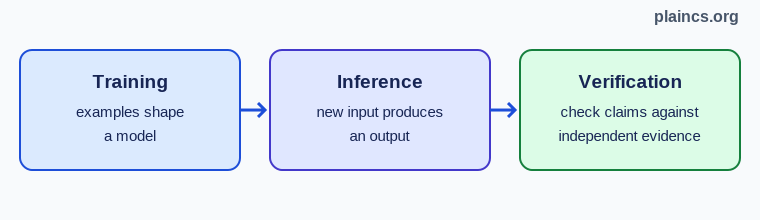
A rule-based program follows instructions written directly by people: “If the reading time is negative, reject the entry.” A machine-learning model instead adjusts internal parameters from examples so it can make predictions on new input. For a simple classifier, training examples might include messages labeled “appointment” or “other.” The words and patterns it uses are features; the category is a label. During training, the model learns from examples. During inference, it applies what it learned to a new message.
The distinction is useful but not absolute. A product may combine rules, learned models, human review, and external data. “AI” is a broad label, and an automated task is not automatically AI. Good performance on familiar examples does not guarantee generalization to a new language, organization, or kind of message. Ask what examples shaped the system and how it was tested.
Check. If a model correctly classifies every training example, will it classify every new example correctly? Answer: No. It may have learned patterns that do not hold outside the training set.
11.2 What generative AI produces
A language model works with tokens, pieces of text. Given a prompt and previous tokens, it estimates likely continuations according to patterns learned during training and the current context. This can produce coherent explanations, summaries, and code. Similar methods can generate images, sound, and other media. The process is powerful, but a fluent sentence is still generated output, not a checked fact.
Some systems also retrieve documents, browse sources, or call tools. That can bring current information into the workflow, but the model may still misunderstand a source or describe a tool result incorrectly. When an AI system claims to have found something, inspect the actual source or result. Generation, retrieval, and verification are distinct steps, even when one interface makes them feel like one action.
Worked example. Ask for a summary of a supplied article. A useful answer should reflect the article’s claims and limits. If the system adds an unsupported statistic, the sentence may sound natural, yet it is not part of the evidence. Check it before repeating it.
11.3 Why a useful answer may still be wrong
AI output can contain unsupported claims, invented references, or a confident answer to an ambiguous question. Training data may reflect unequal coverage or harmful patterns. The system may also lack the context needed for your particular task. A test score is evidence about the test, not a promise for every user and every situation.
When evaluating a model, examples used to test it should be kept separate from examples it learned from. If the answer or a close copy leaked into training, the result may exaggerate how well the model handles new cases. Even a properly separated test can miss a real use case. What matters is performance on the kind of work you actually need, with errors that you can detect and correct.
Try it without an AI account. Compare two fictional statements about this course: (A) “A backup is a separate recoverable copy; synchronization may copy deletions.” (B) “Any synchronized folder is automatically a backup.” Use module 5 to identify which is supported and why. The exercise is about checking claims, not guessing which sentence sounds more polished.
11.4 Using AI with judgment
Start with a clear task. Give the system enough context to be useful, while keeping private or confidential data out unless you understand the service’s rules and have permission to share it. Ask for the reasoning or sources you need, then verify important claims against independent evidence. Test generated code with normal and edge cases. Revise the result in your own words and take responsibility for what you publish or use.
If a tool can take actions—send messages, change files, spend money, or publish content—the risk changes. Review permissions and require checks suited to the consequences. Consider copyright and disclosure rules that apply to your work; they vary by setting, so do not assume one universal answer. If an AI-assisted paragraph affects another person’s decision, be especially clear about what you actually checked.
Module activity. Write a short AI-use plan for a fictional research task. State what the model may help draft, what information you will not upload, which claims require source checks, and who decides whether the result is ready. You can do this entirely on paper.
Check. A model supplies a citation. Is the claim verified? Answer: No. Open the cited source, confirm it exists, and check that the relevant passage supports the claim. A real source can still be misquoted or misapplied.
The next module asks how to choose tools and respond when they fail.