Knowing how a system works does not automatically tell you which tool to use or what to do when it fails. Good decisions begin with the actual need, the people affected, and the evidence you have. They also leave room to change your mind when a test shows you were wrong.
12.1 Troubleshooting without guessing
Start with a symptom you can observe: “The reading-log page opens, but saving a new entry fails.” Record when it started, whether anything changed, and whether it happens on another device or account. A failed page can point to a browser problem, a network problem, a server problem, or a data rule. Do not change several things at once; you will not know which one mattered.
Try one small, reversible check. If other sites work, your whole connection may be fine. If the reading log works in another browser, look at the first browser’s state. If every user sees the same error, the service may need attention. Keep a record of what you tried and what happened. Avoid deleting data, resetting a device, or granting broad permissions as an early guess.
Worked example. The site loads and old entries appear, but adding a new entry returns “Invalid date.” The network is probably carrying requests. Check the exact date value and the required format before investigating Wi-Fi. The error message is evidence about where to look, not absolute proof of the cause.
Check. Why test one change at a time? Answer: If a problem disappears after several simultaneous changes, you cannot tell which action fixed it or whether one introduced a new problem.
12.2 Choosing a tool for a real need
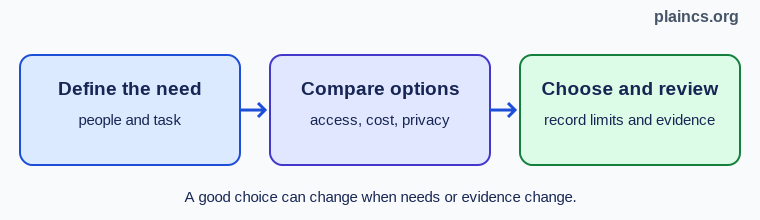
Suppose a community group wants to track volunteer reading sessions. One option is a shared spreadsheet. Another is a dedicated app. List what the group actually needs: who enters data, who sees it, whether it must work offline, whether everyone can use the interface, and how records can be exported. Then compare capability, compatibility, privacy, ongoing cost, and the work of supporting the tool. A feature-rich app can be a poor choice if members cannot access it or retrieve their data later.
Consider an existing tool before buying or building something new. A spreadsheet may be enough for a small, trusted group; a larger service may need stronger access controls and coordinated edits. Be explicit about the tradeoff. “Best” is not a property of the tool alone. It depends on the task and on whose needs count.
Try it. Make a two-column comparison for a fictional group of ten members using a spreadsheet and a dedicated app. Include one accessibility need, one privacy concern, and one cost that is not the purchase price.
12.3 Who benefits, who is excluded, and who decides?
A system can work correctly according to its specification and still be unfair or hard to use. A form that accepts only a mouse excludes some keyboard users. A dataset collected mainly from one group may support weaker decisions about another. A service that asks for more personal information than it needs creates a cost for its users even if the feature is convenient.
Ask who is represented in the design and tests, who can challenge an incorrect result, and who has authority to change the rules. For a reading log, a strict daily goal might motivate some people and discourage others. The right response may be to offer a flexible measure rather than assume one pattern fits everyone. Consent matters when collecting data, and people should know what is recorded and why. Specific legal duties depend on place and context; this course focuses on the questions you should raise, not on universal legal advice.
Check. Does a technically accurate statistic automatically justify a decision about a person? Answer: No. You must also ask what the statistic measures, what it leaves out, and whether that use is fair and appropriate.
12.4 Computing uses physical resources
Devices require materials and energy to make and operate. Data centers and networks also use energy. Repairing and using a suitable device longer can sometimes avoid the cost of replacing it; the exact balance depends on the device and its use. There is no single footprint for “one online action” that applies everywhere. Claims about impact need a defined system and evidence.
Computing also uses attention. Notifications, confusing defaults, and endless feeds can make a useful tool harder to live with. A decision sheet should therefore include maintenance, accessibility, privacy, and the time people spend learning or being interrupted by the product. These are real costs even when no invoice lists them.
Module activity. Recommend a tool for the fictional community group. State the need, two options, your choice, its main benefit, one person it might exclude, one ongoing cost, and what evidence would change your recommendation. Then write a short troubleshooting record for a failed save action.
Check. When might the most technically capable product be the wrong choice? Answer: When its cost, access barriers, complexity, or data rules outweigh the extra capability for the people and task at hand.
The final module brings the course’s ideas into one small project.